The Role of Moist Processes in the Predictability of Indian Ocean Cyclones
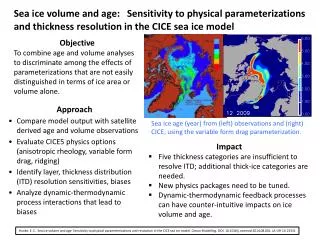
This study investigates the predictability limits of Indian Ocean tropical cyclones and the mechanisms behind error cascades across spatial scales. Utilizing the WRF v3.4 model, four tropical cyclones in the Bay of Bengal were simulated at varying horizontal resolutions (30km, 10km, and 1.1km). Identical twin perturbation experiments quantified model errors and predictability through “error doubling time.” Findings reveal that buoyancy from moist convection significantly influences intrinsic error growth, starting from convection regions and escalating to larger scales.

The Role of Moist Processes in the Predictability of Indian Ocean Cyclones
E N D
Presentation Transcript
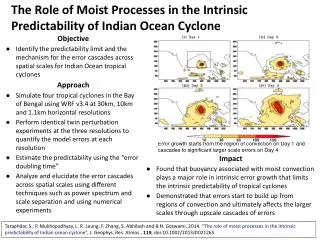
The Role of Moist Processes in the Intrinsic Predictability of Indian Ocean Cyclone • Objective • Identify the predictability limit and the mechanism for the error cascades across spatial scales for Indian Ocean tropical cyclones • Approach • Simulate four tropical cyclones in the Bay of Bengal using WRF v3.4 at 30km, 10km and 1.1km horizontal resolutions • Perform identical twin perturbation experiments at the three resolutions to quantify the model errors at each resolution • Estimate the predictability using the “error doubling time” • Analyze and elucidate the error cascades across spatial scales using different techniques such as power spectrum and scale separationand using numerical experiments Error growth starts from the region of convection on Day 1 and cascades to significant larger scale errors on Day 4 • Impact • Found that buoyancy associated with moist convection plays a major role in intrinsic error growth that limits the intrinsic predictability of tropical cyclones • Demonstrated that errors start to build up from regions of convection and ultimately affects the larger scales through upscale cascades of errors Taraphdar, S., P. Mukhopadhyay, L. R. Leung, F. Zhang, S. Abhilash and B.N. Goswami. 2014. “The role of moist processes in the intrinsic predictability of Indian ocean cyclone”, J. Geophys. Res. Atmos., 119, doi:10.1002/2013JD021265.