Understanding Igneous Rocks: Formation, Classification, and Key Characteristics
Igneous rocks are formed from the cooling and solidification of magma and lava. They can be classified into four primary types: Granite, Diorite, Gabbro (intrusive) and Rhyolite, Andesite, Basalt (extrusive). The characteristics of igneous rocks depend on the conditions under which they form, including cooling rates and mineral compositions. For example, slower cooling results in larger crystals, while rapid cooling leads to small crystals or glassy textures. Understanding their formation provides insight into their role in Earth's geology, including ocean floors and continental origins.

Understanding Igneous Rocks: Formation, Classification, and Key Characteristics
E N D
Presentation Transcript
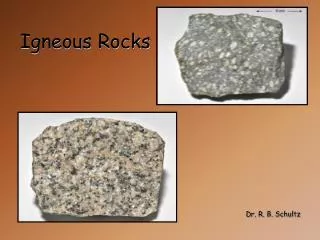
Igneous Rocks • Magma – molten rock below the Earth’s surface • Granite • Diorite • Gabbro • Lava – molten rock extruded on/at the Earth’s surface • Rhyolite • Andesite • Basalt
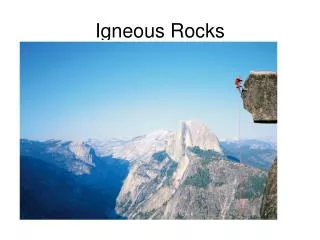
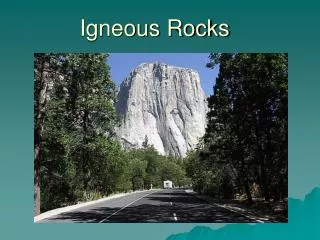
Igneous Rocks • Make up some of the continents oldest rocks • Zoroaster Granite in the Grand Canyon’s Inner Gorge • Compose or underlie all of the Ocean floors • Mid-Ocean ridges • Origin of continents • First continents must have appeared as some extrusive/intrusive complex
Melting Rocks and Crystallizing Magma • Melting preexisting rocks • Various minerals have different melting temperatures • Composition of melt/liquid changes as new elements are introduced through melting process • Crystallizing magmas • Reverse the melting process • High temp minerals begin to crystallize • Composition of melt changes as elements are extracted through crystallization • Mineral crystals grow as cooling continues and eventually form interlocking crystal structure • Size of crystals is directly related to pace of cooling • Fast cooling small crystals • Slow cooling large crystals
Creating Magma • Partial melting • Ice – single mineral melts all at once • Rocks – several minerals that melt at different temps • Heat • Geothermal Gradient • Temperature increases with depth • 50-250km are the depths at which rocks begin to melt • These temperatures are found in the lower crust upper mantle • Radioactive decay • Residual heat from formation of planet • Friction at plate boundaries • Pressure • > depth > pressure • Increases melting temperature • Fluids • Mostly water • Decreases melting temperature • Important at plate boundaries
Bowens Reaction Series • The sequence at which silicate minerals crystallizes as a magma cools • High temp – olivine and Ca-plagioclase • Low temp – quartz and K-feldspar • Continuous and discontinuous sides • Cont = plagioclase series • Ca-rich plag - hi temp • Na-rich plag – low temp • Discont = discrete minerals assemblages
Bowens Reaction Series • Continuous vs discontinuous sides • Simple compositional diagram • To 1st order : where magmas evolve
Igneous Textures • Intrusive – Plutonic • Phaneritic – large crystals, easily seen and identified • Cooled slowly underground • Pegmatities – very large crystals, low temp, high water content, often associated with economic deposits • Extrusive – Volcanic • Aphanitic – small crystals, hard to identify without magnification • Cooled quickly, usually above ground • Volcanic glass – obsidian, pumice
Igneous Compositions • Felsic – light in color • >65% silica • High viscosity • Al, K, Na • Rhyolites (Granites) • Intermediate – usually light in color • 55-65% silica • Medium viscosity • Al, Ca, Na, Fe, Mg • Andesite (Diorites)
Igneous Compositions • Mafic – dark in color • 45-55% silica • Low viscosity • Al, Ca, Fe, Mg • Basalt (Gabbro) • Ultramafic – dark in color • <40% silica • Very low viscosity • Komatiite (Peridotite)
Viscosity of Magmas • Viscosity – measurement of a fluids resistance to flow • Increasing silica content = increasing viscosity (direct correlation) • Decreasing temperature = increasing viscosity (inverse correlation) • Magma rises because • Less dense / hotter than surrounding rock • Assimilation & stoping • Gas content expands as it rises fracturing country rock • Surrounding pressures squeeze it upwards
Basalt (Gabbro) • Most abundant rock in Earth’s crust • Mafic (dark) • Low silica content (45-55%) • Low viscosity • High temp / high pressure • Pyroxene, Ca-feldspar, sometimes olivine (no quartz) • Most abundant rock in the Earth’s crust, dense • Oceanic plates, Hawaiian Islands, Northwest U.S. (Columbia Plateau), San Francisco Peaks and surrounding volcanic field (cinder cones & flows – Sunset Crater) • Effusive (quiet) eruptions
Andesite (Diorite) • Intermediate (salt & pepper colored) • Moderate silica content (55-65%) • Sometimes difficult to distinguish between basalt • Intermediate viscosity • Moderate temp / moderate pressure • Pyroxene, amphibole, intermediate-plagioclase, mica • Second most abundant rock at Earth’s surface • “Typical” volcanic cone (composite cone) • Andes Mtns., Mt. Fuji, Lassen Peak, Mt. Rainier, Mt. St. Helens, Mt. Kilimanjaro, Mt. Etna • San Francisco Peaks • Flows and explosive events
Rhyolite (Granite) • Felsic (light colored) • High silica content (65% or more) • High viscosity • Low temp / low pressure • Intrusive much more common than extrusive • K-feldspars, quartz, Na-feldspars, sometimes micas • Mt. Elden (intrusive dacite, endogenous/exogenous dome) • Super continental pyroclastic eruptions • Yellowstone • Long Valley Caldera • Mt. Mazama/Crater Lake • Mt. Toba • Sierra Nevada batholiths • Prescott – Granite Mtn. and Dells • Inner Gorge Grand Canyon – Zorosater Granite • Explosive eruptions or thick, quiet, slow eruptions
Plate TectonicsOrigin of Basalts/Gabbros • Mid-ocean ridges • divergent plate boundaries • creation of new ocean crust • Gabbros overlain by basalts overlain by sediments • Ocean island hot-spots • Hawaii, Iceland • Some continental hot-spots • Varied composition due to assimilation of surrounding country rock • SF Volcanic Field, Cima Volcanic Field, Columbia Plateau
Plate Tectonics Origin of Andesites/Diorites • Subduction zones • Plate collision boundary where one plate overrides another • Pacific Ring of Fire • Borders Pacific Ocean • Mostly subduction zones • High rate of volcanism and seismic activity • Produced by partial melting of the upper mantle • Inclusion of water and felsic material from the subducting plate • Assimilation of felsic material from surrounding country rock and magma rises
Plate TectonicsOrigin of Rhyolites/Granites • Nearly all occur on continents • Originate from partial melting of crust • Most appear at or near subduction zones • Very viscous • Rise slowly • Generally cool before eruption • Hence larger population of intrusive than extrusive • Produce many economic deposits • Hydrothermal deposits near plutons
Caldera Eruption, felsic, Mt. Toba, Indonesia • Eruption occurred ~67,500-75,500ya • Latest of 3 caldera-forming eruptions (700,000 and 840,000ya) • Volcanic Explosivity Index of 8 (mega-colossal) • possibly the largest explosive volcanic eruption in the last 25 my • Material erupted : • ~ 2,800 km3 (670 cu mi) • 2,000 km3 (480 cu mi) of ignimbrite that flowed over the ground • 800 km3 (190 cu mi) that fell as ash • The pyroclastic flows of the eruption destroyed an area of 20,000 square km (7,722 sq mi), with ash deposits as thick as 600m (1,969 ft) by the main vent • Deposited an ash layer ~15 cm (5.9 in) thick over South Asia • in central India, Toba ash layer up to 6 m (20 ft) thick • parts of Malaysia were covered with 9 m (30 ft) of ash • 10,000 million metric tons of sulphuric acid or 6,000 million tons of sulphur dioxide were ejected into the atmosphere by the event