
The World of Islam: Geography, Origins, and Accomplishments
E N D
Presentation Transcript
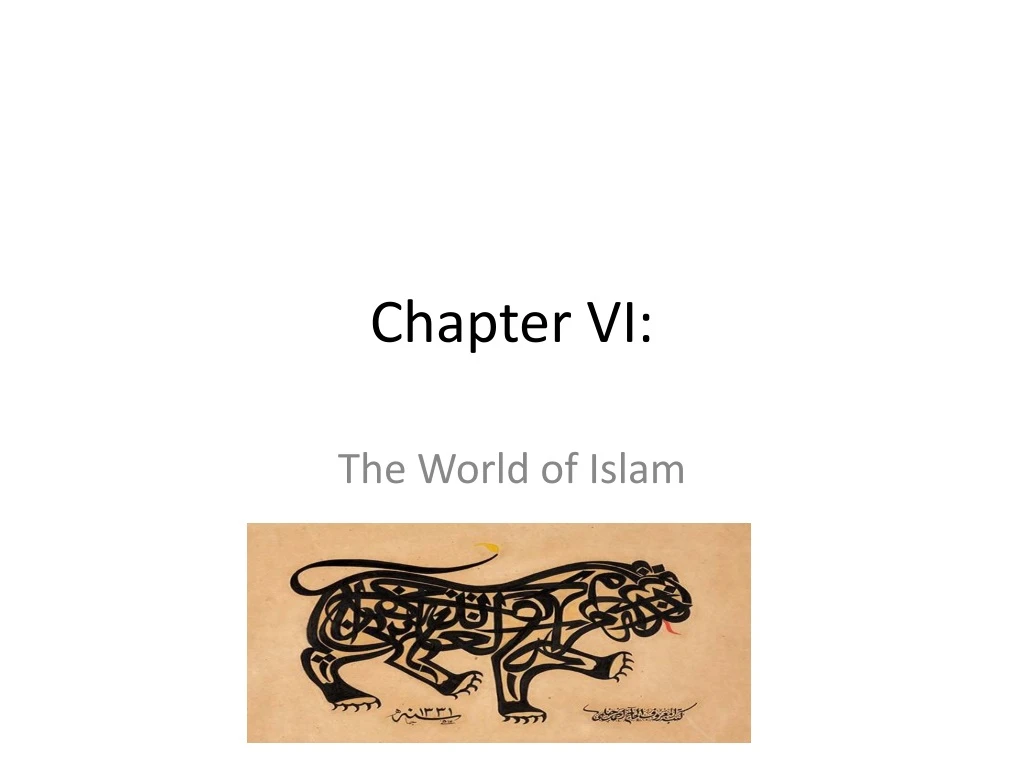
Chapter VI: The World of Islam
Geography • Much of the Arabian peninsula is desert, although there are • mountains in the southwest. Oases are green areas fed by an • underground water source.
Origins • Early Arabs were polytheistic, but Allah was the supreme God • Bedouins= nomadic Arabs who lived in the desert rather than in towns • Jihad= “struggle in the way of God” • Hijrah= journey of Muhammad and his followers to Madinah • Caliph= chief Islamic religious authority • Sultan=holder of power • Muezzin= Muslim crier who calls the faithful to prayer five times a day • Shari’ah= Islamic moral code of law (no gambling, eating pork, drinking alcoholic beverages, or engage in dishonest behavior. • Vizier= prime minister of the council that advised the caliph during the Abbasid dynasty
Muhammad • Muhammad was accepted as a prophet to the people of Arabia. • B. Muhammad was dissatisfied with the ways of his town leaders and • went into the hills to pray. There he was visited by an angel who told • him to preach Islam.
Muhammad returned to Makkah and told people to worship one • God, Allah. Muhammad also preached that all people are equal and • that the rich should share their wealth with the poor. • D. Many poor people began accepting Muhammad’s message and • became Muslims, or followers of Islam. Wealthy people did not like • Muhammad’s message and they made life difficult for Muhammad • and his followers.
Muhammad and his followers left Makkah for Yathrib. This journey • is known as the Hijrah. • F. Yathrib welcomed the Muslims and renamed their city Madinah. • G. Muhammad used the laws he believed he had received from • God to rule the people of Madinah, creating an Islamic state, or • a government that uses its political power to uphold Islam.
Muhammad built an army to defend his new government. The army • conquered Makkah and Muhammad returned to the holy city. • I. Muhammad died two years after his return. • Why • Prophet of Allah • Born in Makkah (Mecca) • Meditated in the hills because he became troubled with the gap between the honesty of most Makkans and the greediness of trading elites in the cities • Muhammad believed the message given to him by Gabriel was the final revelations of Allah. • The Quran contains the ethical guidelines and laws by which Muslims are to live • Why no representations of Muhammad in mosques (Islamic houses of worship)? • The Hadith warns against any attempt to imitate God by creating pictures of living things
Daily Life and Society • Women • According to Islam, all people are created equal in the eyes of Allah (god); HOWEVER, men in actuality were dominant in Islamic society. Women had to have a male guardian. Women were required to be secluded in their homes and kept away from males…and cover virtually all parts of their body • Polygamy accepted
Accomplishments/Advances • Islamic scholars made contributions to math and the natural sciences that were passed on to the West • Muslims adopted and passed on the numerical system of India, including the use of zero • Algebra
Astrolabe= an instrument used for ship navigation • Developed medicine as a field of scientific study • Ibn Sina (philosopher and scientist)stressed the contagious nature of certain diseases • Omar Khayyam= writer (Rubaiyat)
Islamic Split: Sunni and Shiite • After Muhammad’s death, the Muslims split into two groups: the • Sunnis and the Shiites. • B. Shiites believed that Muhammad’s son-in-law, Ali, should succeed • Muhammad and that all future caliphs should be descendants of Ali. • Sunnis believe that the Umayyad caliphs were rightful leaders. Over • time, these two groups developed their own customs. • C. The Umayyad dynasty lost power and was replaced with a new • dynasty called the Abbasids.
The Abbasids built a new capital, Baghdad. Baghdad prospered as a • center of trade because of its central location. • E. The Abbasids lost control as Muslims in other parts of the world • wanted their own caliphs. • F. The Seljuk Turks was nomads and warriors. They gradually took • control of the Abbasid dynasty. The Seljuk ruler was called a sultan. • G. The Arab Empire ended when the Mongols invaded Baghdad and • burned it to the ground.
Resentment against the Umayyad grew because non-Arab Muslims did not like the way local administrators favored Arabs • Mongols • 1. Many of the Mongols converted to Islam. • 2. They intermarried with the local people. • 3. Over time, the Mongols rebuilt the cities they destroyed during the invasion.