Circuits
This article explores the fundamental concepts of electric circuits, specifically focusing on series and parallel circuits. A circuit is a complete path for electric charge flow, with series circuits having the same current throughout and parallel circuits allowing independent operation of devices. We discuss the advantages and disadvantages of each circuit type, their everyday applications in household items, and the implications when one component fails. By comparing series and parallel circuits, we highlight why parallel circuits are more widely used in daily life.

Circuits
E N D
Presentation Transcript
Circuits By: Justin Elnicky, Stephanie Martella, Brian Nielson, Derek Rascon
Texting Poll • http://www.polleverywhere.com/multiple_choice_polls/LTE1OTQwOTQxOTg
Explanation of a circuit • Any complete path along which electric charge can flow.
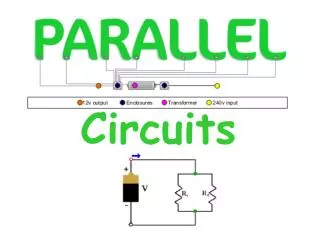
Different types of circuits • Series Circuit- Electric circuit with devices connected in such a way that the electric current through each of them is the same. • Parallel Circuit- Electric circuit with two or more devices connected in such a way that the same voltage acts across each one and any single one completes the circuit independently of the others.
Series circuit • In a series circuit the current of electricity is stopped when one of the bulbs in the circuit dies or the switch is opened. • This happens because the electricity can no longer continue to flow in a current.
Prosandconsofseriescircuits • Pros • They are simpler circuit to make. • They use less energy than a parallel circuit. • You can add power to their input and increase their voltage. • Cons • If one bulb in a circuit goes out or dies, then the rest of the bulbs go out.
Parallel circuit • A parallel circuit is organized in a way that when one bulb dies the other(s) do not. • Ex.. When one of the head lights on your car dies the other keeps working.
Pros and cons of parallel circuit • Pros • If one bulb dies the rest of the bulbs stay lit. • It can power many light sources giving all of them their required voltage. • Cons • Can receive damage if the voltage gets too low.
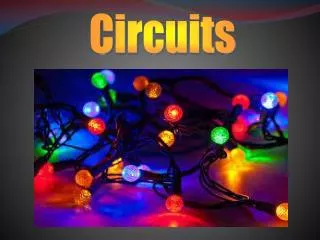
Everyday uses of circuits • There are circuits in nearly everything that we use that deals with electricity. • Lights in our houses. • Appliances • Christmas lights and headlights in our cars.
Conclusion • Circuits are important in our daily lives. • Each different circuit has it’s good and bad side. • In most cases, parallel circuits are more commonly used.