Download
1 / 8
80 likes | 182 Views
Le Chatelier’s principle:. if a system at equilibrium is disturbed, the system will move in such a way as to counteract the disturbance. Types of disturbances:. a. Concentration. b. Pressure - with gases, relates to concentration. c. temperature (energy). Concentration:.

E N D
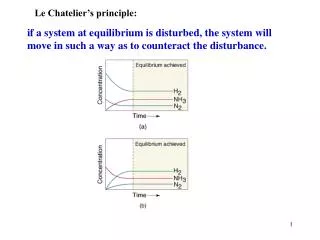
Le Chatelier’s principle: if a system at equilibrium is disturbed, the system will move in such a way as to counteract the disturbance.
Types of disturbances: a. Concentration b. Pressure - with gases, relates to concentration c. temperature (energy)
Concentration: PCl3(g) + Cl2 (g) PCl5(g) add more Cl2? remove some PCl3? Do concentration changes affect the value of K?
Pressure: 4NH3(g) + 5O2(g) 4NO(g) + 6H2O(g) Increase pressure? Decrease pressure? Do pressure changes affect the value of K? CH4(g) + 2S2(g) CS2(g) + 2H2S(g) increase pressure? CO2(g) + C(s) 2CO(g) increase pressure?
Heat: Ho = - 21.7 kcal CO(g) + 2H2(g) CH3OH(g) CO(g) + 2H2(g) CH3OH(g) + heat So RXN is : add Heat? What effect does a heat change have on the value of K? Remove Heat? Then in this case heat is a product. Is this endo or exo thermic?
Heat: 2H2O(g) 2H2(g) + O2(g) H = 484 kJ Is heat a product or a reactant? So: 2H2O(g) + heat 2H2(g) + O2(g) H = 484 kJ add heat? remove heat?
Temp. Changes: N2(g) + O2(g) 2NO(g) K@2500K = 36 x 10-4 K@2000K = 4.1 x 10⁻⁴ So is heat a product or a reactant? N2(g) + O2(g) + heat 2NO(g)
External factors affecting Equilibria: Effect: Factor: value of K changes 1. Temp Change 2. Conc. change also pressure changes with gases RXN shifts to maintain value of K since K = constant: Eq mixture is the same, but Eq is reached faster. (rate is increased) 3. catalyst