Understanding Trematodes and Schistosomiasis: A Global Health Concern
Trematodes, or flatworms, cause significant diseases such as schistosomiasis, which is primarily caused by blood flukes like Schistosoma haematobium, S. japonicum, and S. mansoni. Common in Africa, the Middle East, and Asia, these parasites can lead to diverse symptoms, including dermatitis, abdominal pain, and urinary tract issues. Infected individuals may remain asymptomatic or develop severe complications, including bladder cancer. Other trematodoses involve Fascioliasis, Clonorchiasis, and Dicrocoeliasis, impacting various organs and causing inflammation. Awareness and preventive measures are crucial for public health.

Understanding Trematodes and Schistosomiasis: A Global Health Concern
E N D
Presentation Transcript
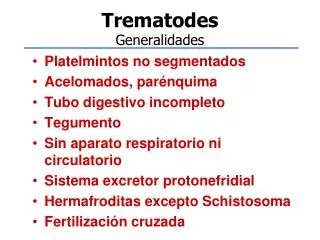
Schistosomiasis • Caused by blood flukes • Most common • S. haematobium • Africa and Middle East • S. japonicum • Far east Asia • S. mansoni • South America, Caribbean and Africa
S. mansoni and S. japonicum • Can be asymptomatic • Acute disease • Skin • Dermatitis at site of cercaria entry • GI tract • Abdominal pain, diarrhea, ascites • Hepatosplenomegaly • Enlarged liver and spleen • Brain • Ectopoic eggs can cause lesions
S. haematobium • Infects urinary tract • Cystitis, ureteritis, hematuria • Bladder cancer • Leading cause in affected areas
Schistosoma Eggs • S. mansoni S. japonicum S. haematobium
Clonorchiasis • Clonorchis sinensis • Asia including Korea, China, Taiwan and Vietnam • Inflammation and obstruction of biliary ducts • Chronic infections can cause cancer of the biliary ducts
Key for Images • Key • AC=acetabulum (ventral sucker) • IN=intestine • CE=cecum • OS=oral sucker • CL=collar • OV=ovary • CS=cirrus sac • PH=pharynx • EB=excretory bladder • SR=seminal receptacle • EG=eggs (within uterus) • TE=testes • ES=esophagus • UT=uterus • GA=genitoacetabulum • VT=vitellaria
Fascioliasis • Fasciola hepatica (sheep liver fluke) • Worldwide • Fasciola gigantica • Asia, Africa, Hawaii • Inflammation and obstruction of biliary ducts • Abdominal pain, fever vomiting and diarrhea • Hepatomegaly (enlarged liver)
Key for Images • Key • AC=acetabulum (ventral sucker) • IN=intestine • CE=cecum • OS=oral sucker • CL=collar • OV=ovary • CS=cirrus sac • PH=pharynx • EB=excretory bladder • SR=seminal receptacle • EG=eggs (within uterus) • TE=testes • ES=esophagus • UT=uterus • GA=genitoacetabulum • VT=vitellaria
Fasciolopsiasis • Fasciolopsis buski • Light infections are asymptomatic • Heavy infections • Diarrhea, abdominal pain, fever and ascites • Intestinal obstruction can occur • Eggs indistinguishable from Fasciola hepatica
Fasciolopsis and Fasciola Eggs Fasciolopsis Fasciola
Dicrocoeliasis • Dicrocoelium dendricitum • Most common in grazing ruminants • Rare in humans, carnivores and other herbivores • Worldwide distribution • Metacercariae in ants cause change in behavior