Download

1 / 4
0 likes | 2 Views
Explore the surge in frozen fruit and vegetable consumption in Thailand. Ken Researchu2019s report<br> details farm-to-freezer value chain dynamics, retail adoption, and export diversification.https://www.kenresearch.com/industry-reports/thailand-frozen-foods-market?utm_source=blog&utm_medium=referral&utm_campaign=rajni

E N D
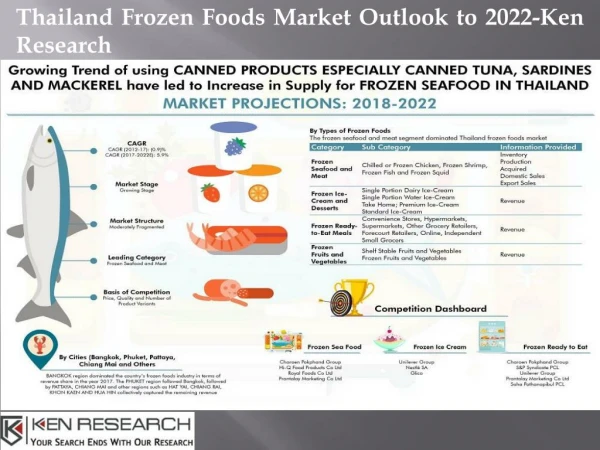
Thailand Frozen Foods Market Outlook 2022 – Size, Growth & Forecast 1. What is the current size of the Thailand frozen foods market size? According to the detailed analysis in the Ken Research report, the Thailand frozen foods market size is examined across multiple product categories such as frozen seafood & meat, frozen ice-cream & desserts, frozen ready-to-eat meals and frozen / processed fruits & vegetables. While exact numeric values are not publicly disclosed in the free summary, the study highlights that the frozen seafood and meat segment dominated in 2017 owing to rising consumption of seafood and meat.Ken Research The growing penetration of hypermarkets, convenience stores and internet retailing further supports an expanding market size. The report also projects growth through to 2022 for the Thailand frozen foods market. For stakeholders looking into market entry or expansion, understanding the market size provides a foundation for forecasting demand, benchmarking competition and identifying capacity needs. 2. How has growth trended historically and what is the Thailand frozen foods market growth forecast to 2022? The historic growth of the Thailand frozen foods market witnessed moderate fluctuations from 2012 to 2017. The report notes that revenue generation slowed down after 2012 due to political turmoil and high oil prices, which reduced production volumes, sales and margins. However, going forward the forecast indicates positive momentum: the Thailand frozen foods market growth is expected from 2017 through 2022 (2017-2022E) across all the product segments. The key growth drivers include the rising demand for processed and ready-to-eat meals, increasing retail penetration and the flourishing food processing industry in Thailand. Stakeholders can use this forecast growth to plan capacity expansions, tailor product portfolios and allocate marketing resources. 3. What are the key opportunities in the Thailand frozen foods market opportunities for players between now and 2022?
In the report, the Thailand frozen foods market opportunities emerge in several areas. One major opportunity lies in the growth of value-added frozen seafood and meat products, driven by rising exports to Japan, Australia, China, Korea, the US, EU and Middle East. Another opportunity is the increasing demand for convenience foods—frozen ready-to-eat meals—as Thai consumers in urban centres adopt busier lifestyles.The processed fruits & vegetables segment also offers opportunity due to rising interest in exotic Thai fruits and vegetables for export or value-added frozen forms. Ken Research For manufacturers and investors, capturing these opportunities means focusing on innovation in freezing technology, expanding cold-chain infrastructure and enhancing retail distribution networks. 4. How is the market segmented by product type in the Thailand frozen foods market segmentation by type? The report provides detailed breakdowns under the Thailand frozen foods market segmentation by type of frozen foods and by city. The types covered include frozen seafood & meat (such as chilled/frozen chicken, frozen shrimp, fish and squid), frozen ice-cream & desserts (single-portion dairy, water-ice, take-home; premium vs standard), frozen ready-to-eat meals and frozen/processed fruits & vegetables (shelf-stable vs frozen). This segmentation allows market players to identify high-growth sub-segments and target distribution channels accordingly. For example, frozen seafood & meat dominated the market in 2017. Understanding the breakdown helps in tailoring product development, marketing strategies and supply-chain planning to specific segments. 5. Which cities and regions dominate the Thailand frozen foods market? The report shows that geographical distribution is a key factor in the Thailand frozen foods market by cities. The Bangkok region dominated the country’s frozen foods industry in 2017, driven by consumer demand for convenient packaged foods such as frozen seafood & meat. This was followed by tourist and resort regions like Phuket and Pattaya, then Chiang Mai and other regions such as Hat Yai, Chiang Rai, Khon Kaen and Hua Hin. From a strategic standpoint, this geographic insight helps companies allocate marketing and logistics resources, decide on production hub placement and assess regional consumer preferences for frozen foods. 6. What are the main trends driving the Thailand frozen foods market trends?
Key trends in the Thailand frozen foods market trends include the increasing consumer preference for processed and packaged ready-to-eat meals, supported by freezing innovations that extend shelf life. There is also rising health consciousness among consumers, leading to demand for reduced-fat, no-sugar-added, lactose-free or gluten-free frozen ice-creams and desserts.Ken Research Furthermore, export growth and tourism demand boost frozen seafood and meat segments, while development of cold-chain infrastructure enhances market reach. For market participants, aligning product offerings with these trends can grant competitive advantage and better serve evolving consumer demands. 7. What is the competitive landscape in the Thailand frozen foods market competitive landscape? The report highlights that the competitive structure varies by segment. In the frozen seafood & meat segment, the Thailand frozen foods market competitive landscape is highly fragmented, with many players processing and exporting a wide variety of seafood and meat products.In contrast, the frozen ice-cream & desserts segment is more concentrated with major international brands present in Thailand. For new entrants and existing players alike, understanding such competitive segmentation helps in defining market entry strategy, pricing policy, brand positioning and potential partnerships or acquisitions. 8. What regulatory and structural factors affect the Thailand frozen foods market regulatory environment? Within the report, the Thailand frozen foods industry regulatory environment is discussed comprehensively, covering import/export controls, food processing standards, cold-chain infrastructure and the value chain. Structural factors such as production zones in outer Bangkok, Rayong, Chantaburi, Chiang Mai and Lampoon influence cost structures and logistics. Ken Research These regulatory and structural dynamics shape market entry costs, compliance requirements, supply-chain risk, and time-to-market for frozen foods. Companies must carefully map the regulatory landscape to avoid delays, sanctions or inefficiencies. 9. What role does the Thailand frozen foods market value chain analysis play in strategic planning? The report provides a dedicated value chain analysis for the Thailand frozen foods market value chain analysis, examining major entities—from raw material sourcing, freezing and processing, distribution through hypermarkets, supermarkets, convenience stores, to export logistics. Understanding this value chain helps firms identify key cost drivers, bottlenecks,
potential value-capture points and areas for efficiency improvement. For example, cold-chain logistics and internet retailing channels form part of the value chain and can be leveraged for competitive advantage. By mapping the value chain, companies can align investments, partnerships and process improvements in line with market dynamics. 10. How does the Thailand frozen foods market export and import trends impact domestic market growth? The report’s section on trade scenario shows the Thailand frozen foods market export and import trends including import values/volumes (2012-2016) and export values/volumes. Export demand from major markets such as Japan, Australia, China, Korea, Middle East, the US and EU has been rising and this strengthens domestic production and encourages investment in freezing and processing capacity. Ken Research On the import side, access to frozen foods from abroad influences domestic competition and product variety. For market players, these trade trends signal export opportunity, need for compliance with international standards, and potential for leveraging Thailand as a production hub for ASEAN or global frozen-food distribution. If you’d like to gain deeper insight into the full data, trend-analysis, segmentation and forecast for the Thailand frozen foods market, consider the full report by Ken Research here: Thailand Frozen Foods Market Report. Contact Ken Research today to access a customised version tailored to your business needs and to unlock market intelligence for strategic decision-making