Understanding Electrochemistry Basics: Definitions, Concepts, and Applications
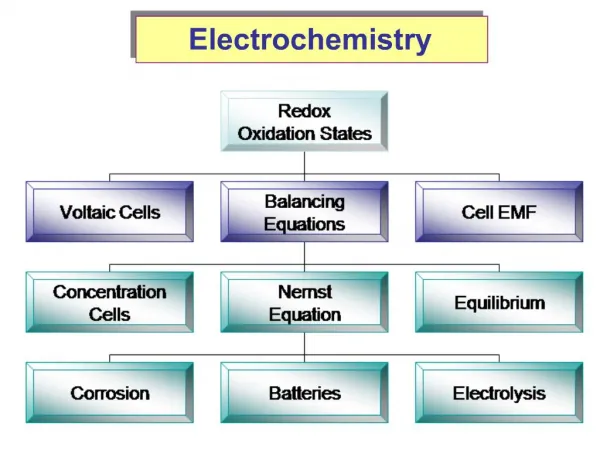
Learn about oxidation, reduction, anode, cathode, reduction potentials, Galvanic cells, Nernst equation, and electrolysis processes in electrochemistry. Explore terminology, memory devices, and practical applications with detailed explanations. Improve your understanding of key concepts in electrochemistry.

Understanding Electrochemistry Basics: Definitions, Concepts, and Applications
E N D
Presentation Transcript
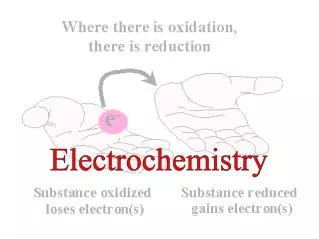
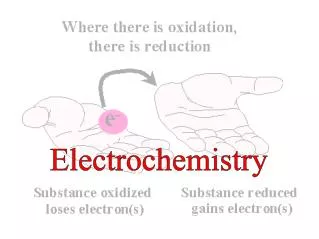
Electrochemistry Terminology #1 • Oxidation – A process in which an element attains a more positive oxidation state Na(s) Na+ + e- • Reduction – A process in which an element attains a more negative oxidation state Cl2 + 2e- 2Cl-
Electrochemistry Terminology #2 An old memory device for oxidation and reduction goes like this… LEOsaysGER LoseElectrons =Oxidation GainElectrons=Reduction
Electrochemistry Terminology #3 • Oxidizing agent** The substance that is reduced is the oxidizing agent • Reducing agent** The substance that is oxidized is the reducing agent **Terminology of reducing agent and oxidizing agent have been excluded from the course.
Electrochemistry Terminology #4 • Anode The electrode where oxidation occurs • Cathode The electrode where reduction occurs Memory device: Reduction at the Cathode
Table of Reduction Potentials Measured against the StandardHydrogenElectrode
Measuring Standard Electrode Potential Potentials are measured against a hydrogen ion reduction reaction, which is arbitrarily assigned a potential of zero volts.
Galvanic (Electrochemical) Cells Spontaneous redox processes have: A positive cell potential, E0 A negative free energy change, (-G)
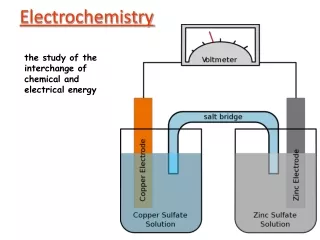
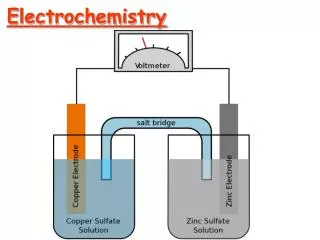
Zn - Cu Galvanic Cell Zn2+ + 2e- Zn E = -0.76V Cu2+ + 2e- Cu E = +0.34V From a table of reduction potentials:
Zn - Cu Galvanic Cell Cu2+ + 2e- Cu E = +0.34V The less positive, or more negative reduction potential becomes the oxidation… Zn Zn2+ + 2e- E = +0.76V Zn + Cu2+ Zn2+ + Cu E0 = + 1.10 V
Line Notation An abbreviated representation of an electrochemical cell Zn(s) | Zn2+(aq) || Cu2+(aq) | Cu(s) Anode material Cathode material Anode solution Cathode solution | || |
Calculating G0 for a Cell G0 = -nFE0 n= moles of electrons in balanced redox equation F=Faraday constant = 96,485 coulombs/mol e- Zn + Cu2+ Zn2+ + Cu E0= + 1.10 V
Excluded from the AP Chemistry Course! The Nernst Equation Standard potentials assume a concentration of 1 M. The Nernst equation allows us to calculate potential when the two cells are not 1.0 M. R= 8.31 J/(molK) T = Temperature in K n = moles of electrons in balanced redox equation F = Faraday constant = 96,485 coulombs/mol e-
Nernst Equation Simplified At 25 C (298 K) the Nernst Equation is simplified this way:
Equilibrium Constants and Cell Potential At equilibrium, forward and reverse reactions occur at equal rates, therefore: • The battery is “dead” • The cell potential, E, is zero volts Modifying the Nernst Equation (at 25 C):
Calculating an Equilibrium Constant from a Cell Potential Zn + Cu2+ Zn2+ + Cu E0= + 1.10 V
??? Concentration Cell Both sides have the same components but at different concentrations. Step 1: Determine which side undergoes oxidation, and which side undergoes reduction.
??? Concentration Cell Both sides have the same components but at different concentrations. Anode Cathode The 1.0 M Zn2+ must decrease in concentration, and the 0.10 M Zn2+ must increase in concentration Zn2+ (1.0M) + 2e- Zn (reduction) Zn Zn2+ (0.10M) + 2e- (oxidation) Zn2+ (1.0M) Zn2+ (0.10M)
Concentration Cell ??? Concentration Cell Both sides have the same components but at different concentrations. Anode Cathode Step 2: Calculate cell potential using the Nernst Equation (assuming 25 C). Zn2+ (1.0M) Zn2+ (0.10M)
Nernst Calculations Zn2+ (1.0M) Zn2+ (0.10M)
Electrolytic Processes Electrolytic processes are NOT spontaneous. They have: A negative cell potential, (-E0) A positive free energy change, (+G)
Electrolysis of Water In acidic solution Anode rxn: -1.23 V Cathode rxn: -0.83 V -2.06 V
Electroplating of Silver Anode reaction: Ag Ag+ + e- Cathode reaction: Ag+ + e- Ag Electroplating requirements: 1. Solution of the plating metal 2. Anode made of the plating metal 3. Cathode with the object to be plated 4. Source of current
Solving an Electroplating Problem Q: How many seconds will it take to plate out 5.0 grams of silver from a solution of AgNO3 using a 20.0 Ampere current? Ag+ + e- Ag 5.0 g 1 mol Ag 1 mol e- 96 485C 1 s 20.0 C 1 mol e- 107.87 g 1 mol Ag = 2.2 x 10² s