Understanding Motion, Vibration, and Acceleration: Effects and Management Strategies
This comprehensive overview explores the intricate relationship between motion, vibration, and acceleration, detailing how they impact human physiology and perception. It distinguishes between voluntary and non-voluntary motions, addressing issues like motion sickness and the physiological responses to vibration exposure. The text discusses various types of vibrations and their effects on performance, safety, and comfort. Key management strategies for controlling vibration exposure in transportation and industrial settings are highlighted, emphasizing the importance of reducing intensity, avoiding resonance, and using isolating tools to protect against harm.

Understanding Motion, Vibration, and Acceleration: Effects and Management Strategies
E N D
Presentation Transcript
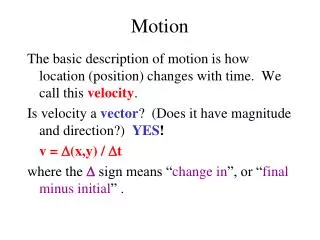
Motion • Main Topics • Vibration • Acceleration • Illusions during Motion • Motion Sickness
Two General Classes of Motions • Volitional, Low-Speed • Issues Concerned: • Non-Volitional, High-Speed • Issues Concerned: • Tolerance • Safety and protection • Impact and acute effects • Illusion • * Vibration a special entity • Permanence (S-A trade-off) • Strategy to minimize stress • Accumulative effects (low force) • Acute effect (forceful exertion)
Senses Related to Motion • Sensory Receptors • Exteroceptors • Proprioceptors • Semicircular Canals • Vestibular Sacs • —postural/balance sensors • (Figure 19-1) • Conflict between visual perceptions and actual gravity —deal with stimuli external to the body —stimulated by body’s own actions —acceleration/deceleration sensors
Ways to Describe Vibration • Type (Wave Form) • Sinusoidal vs. Random • Direction • Forward-Backward • Left-Right • Up-Down • Frequency • Cycles per second • Intensity • Amplitude (Displacement) • Velocity • Acceleration • Rate of acceleration change
Effects of Vibration on the Body • 1. Transmission • Attenuation • Amplification • Resonance • 3-4 Hz Resonance in cervical (neck vertebrae) • 4 Hz Peak resonance in lumbar • (upper torso) vertebrae • 5 Hz Resonance in shoulder girdle • 20-30 Hz Resonance between head and shoulders • 60-90 Hz Resonance in eyeballs
Effects of Vibration • 2. Physiological Effects • Short-term exposure • increased HR • increased muscle tension • urge to urinate • chest pain • Long-term exposure • increased risk of disc herniation • increase risk of low-back pain • increased risk of Reynaud’s Syndrome or Traumatic Vasopastic Disease (TVD)
Effects of Vibration • 3. Performance • Visual Performance • impaired by vibration of 10-25 Hz • minor effect in low frequency range due to head/eye compensatory motion • Motor Performance • vertical sinusoidal vibration of 4-20 Hz most detrimental • dependent on display and control • Neural Process • central neural processes (e.g., RT, pattern recognition) highly resistant to vibration effect • tension in muscle increases vigilance
Subjective Responses Whole-Body Vibration • Comfort scale • mildly uncomfortable • annoying • very uncomfortable • alarming • Attempt to link frequency & acceleration to comfort scales • Equivalent-comfort contours • Large inter-person variability makes design considerations challenging
Limits of Exposure to Whole-Body Vibration • Criterion-based • comfort, task performance, or physiological response • ISO 2631 • most applicable for transportation and industrial type vibration exposures • Fatigue-Decreased Proficiency (FDP) • Figure 19-7, page 634
Limits of Exposure to Whole-Body Vibration • Criticisms of FDP: • 1. Comfort and FDP limits for short exposures maybe too high • 2. Appear to be based on mean results • 3. Imply the effects of multiple single-axis vibrations are additive • 4. Similar shaped contours are an oversimplification • 5. Comfort contours may be inaccurate at extreme frequencies • 6. Assumes time/intensity trade-off with little support
Control of Vibration • Source Control • Reduce intensity • Avoid resonance • Provide tool balancing • Use non- or less vibratory tools • Path Control • Provide rest period • Reduce transmission (attenuate) • Use isolator • Receiver Control • Use isolating or damping apparatus • Adopt more “resistant” postures • Reduce grip force • Reduce contact area
Acceleration • Terminology • 1. Acceleration: • Rate of change of motion • 2. Linear acceleration: • Rate of change of velocity • 3. Rotational acceleration: • Rate of change of direction • Radial (centrifugal) acceleration • Angular (tangential) acceleration • Nystagmus: • involuntary oscillatory movement of the eyeball
Acceleration • Direction (Figure 19-8) • 1. X-Axis: Forward/Backward • 2. Y-Axis: Left/Right • 3. Z-Axis: Headward/Footward • Follows right-hand rule (RHL) Look at motion of the eyeballs to determine the direction of acceleration Eyeballs go opposite of acceleration, and same direction as deceleration
Acceleration • 4. Tumbling • 5. Spinning Head over heels • Around main body axis • - spiral nose dive • - forces alternate +/-
Acceleration Duration • Sustained • Abrupt • Begins at 2/10 second and • continues • Effects are primarily physiological • Shorter acceleration, less than • 2/10 second • Mainly effects of impact or rapid • deceleration • Effects are primarily physical
Acceleration Duration • Three Categories • Short • Intermediate • Long - less than 1 second - impact or acute effect - 1/2 to 2 second duration - very abrupt - greater than 2 seconds through several minutes
Methods of Study • Tracks • Centrifuges • Suicides/Accidents • Usually acceleration/deceleration studies performed on tracks • Slide/ejection tests in impact laboratories • Help to study the effect of non-linear acceleration • Rotary chairs or vehicles • Haven - Golden Gate Bridge and Brooklyn Bridge • “Real field studies” if caught on tape • Reconstruction or simulation
Resulting Forces on the Body -Gz “Eyeballs Up” -Gy “Eyeballs Right” +Gx “Eyeballs In” -Gx “Eyeballs Out” +Gy “Eyeballs Left” +Gz “Eyeballs Down”
Effects of Directional Forces • Effects of +Gz (Figure 19-9) • Acceleration headward • Increase in weight; drooping of face and soft tissues • Difficult or impossible to raise oneself • Blackout; loss of consciousness • Cardiac output and stroke volume decrease while HR, aortic pressure, and vascular resistance increase • Maximum Tolerance = ~16 G
Effects of Directional Forces • Effects of -Gz • Acceleration footward • facial congestion • headache • blurring, graying, reddening of vision • Limit at -5 G is about 5 s • Maximum Tolerance = ~10 G
Effects of Directional Forces • Effects of +Gx (Fig 19-10, -11) • Acceleration sternumward • Speech difficult • Progressive tightness and pain in chest • Difficulty in lifting body parts • Blurring of vision • Dyspnea • Maximum Tolerance = ~30 G
Effects of Directional Forces • Effects of -Gx • Acceleration spineward • Effects the opposite of +Gx • Tolerance = ~30G
Effects of Directional Forces • Effects of +/- Gy • little information on these effects • mainly encountered in an aircraft • magnitude is relatively small compared to other directions • less common in occupational settings
Deceleration (Impact) • Exposures less than 2/10 second • Extremely abrupt • Reverse acceleration • Mainly in forward/backward direction
Duration Rate of Onset G t0 t1 t2 t3 Deceleration (Impact) Magnitude
Deceleration (Impact) • Factors affecting the impact of an impact • Rate of Onset • Peak G • Stopping Distance • Angle of Impact
Tolerance • Survivable • limit around 30-40 G’s • can only endure for 0.25 seconds • Injury • Death • 60 G with rate of onset 5000 G/sec • 200 G with rate of onset 5000 G/sec
Protection • 1. Restraining Devices • seat belt • 2. Absorbing Devices • air bag • 3. Special Contoured Seats • secondary collision minimized • 4. Body Posture • direction-dependent stiffness or resistance • 5. Water Immersion • damping • 6. Anti-G Suits • can take up to 9 G
Weightlessness • Two Aspects • absence of weight itself • tractionless condition • Both remain to be fully investigated • Physiological Effects • Performance Effects • space sickness (space adaptation syndrome) • anthropometric change: height growth 3% • relaxed posture assumed • (Figure 19-13) • exhaustion due to the added third dimension in locomotion
Illusions During Motion • Human senses are not designed for extremely dynamic motions and unusual, prolonged forces encountered in special settings • Disorientation from False Sensations (due to inaccurate sensory information) • disrupted vestibular-visual coordination: illusion of spinning in opposite direction • Coriolis illusion: illusion of roll during turning or circling motion • oculogravic illusion: impression of tilt during a sudden increase of forward speed
Illusions During Motion • Disorientation from Misperception • (due to brain’s misinterpretation or misclassification of accurate sensory information • Autokinesis: • fixed light appears to be moving against a dark background
Eyes Kinesthetic (body position) Motion Sickness • Cause: incongruities among senses Vestibular (inner ear tubes)
Motion Sickness • Head Symptoms • drowsiness • general apathy • Gut Symptoms • nausea • vomiting • Sensory Rearrangement Theory • sensory systems provide contradictory information • Simulator Sickness • exact cause unknown