Download
1 / 16
200 likes | 356 Views
Explore the fascinating Continental Drift Theory of Alfred Wegener, the German meteorologist who proposed that continents moved to their current positions. Discover PANGAEA, GONDWANA, LAURASIA, and the historical context behind this groundbreaking theory. Delve into the evidence, such as jigsaw puzzle-like fits, fossil discoveries, and mountain range formations, supporting Wegener's ideas. Unravel the debates and challenges faced by Wegener as he sought acceptance for his revolutionary theory. Learn about centrifugal forces, glacial evidence, and the enduring legacy of the Continental Drift Theory.

E N D
MOVING CONTINENTS Theory of Continental Drift
Alfred Wegener -German Meteorologist -Jigsaw Puzzle effect -Fossil Evidence -Centrifugal Force
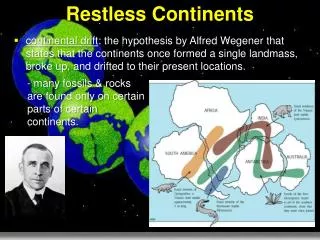
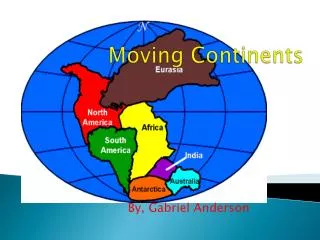
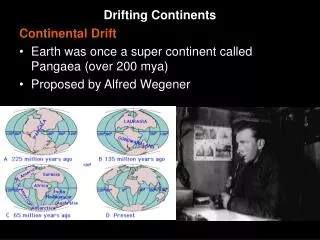
Continental Drift Theory Alfred Wegener (1880 - 1930) – German meteorologist suggested in 1912 that continents have moved slowly to their current positions • PANGAEA – ≈ 250 m.y.a. all continents were once connected as one large land mass • GONDWANA & LAURASIA - ≈ 180 - 200 m.y.a. land mass broke apart, and the Earth’s continents began drifting to present locations
PANGAEA GONDWANA & LAURASIA
History of Continental Drift Theory • Thoughts about continental drift had been around for a very long time • Sir Francis Bacon in the early 1600s had written about it • Most based theory on deduction and small pieces of evidence • Wegner gathered a larger and more complete body of evidence
Evidence for Continental Drift • JIG SAW PUZZLE-like fit of the continents • FOSSILS – similar fossils on different continents • Glossopteris - ferns • Lystrosaurus – reptile fossils found in S. Africa, Antarctica, India, China • Warm weather plant fossils found in Arctic regions • GLACIAL DEPOSITS – found in areas presently in the tropics
Grooves carved by glaciers (shown by arrows) provided evidence for continental drift. Glacial Evidence
More Evidence • Similar rock structures on different continents • COAL BEDS • MOUNTAIN RANGES • rocks on the east coast of S. America match those on the west coast of Africa, tests reveal they formed at the same time (550 mya) • belt of mountains along the east coast of N. America match those existing in northern Europe
MOUNTAIN RANGES • Explanation for their existence • Cooling, Contracting-Earth Theory • they formed on the Earth's crust as wrinkles form on the skin of a drying apple. If this were so, however, they should be spread evenly over the Earth; instead mountain ranges occur in narrow bands, usually at the edge of a continent. • Continental Drift (WEGENER) • Mountains formed when the edge of a drifting continent crumpled and folded—as when India hit Asia and formed the Himalayas.
No Support for Continental Drift? Flaws with theory at the time: • Earth’s crust was believed to be too rigid; • No suitable mechanism to provide enough energy to move the continents such great distances could be identified – Earth does not spin fast enough!
Continental Drift NOT Accepted NOT accepted because how or why continents had moved could not be explained!! • Wegner tried to base movement of continents on gravitational pull and centrifugal force! • The fact that Wegner was a meteorologist led some people to not believe his thoughts on geology – particularly when he could not provide evidence to support his hypothesis.
Why wasn’t the Theory of Continental Drift Accepted? METEOROLOGIST vs. GEOLOGIST DRIVING FORCE = CENTRIFUGAL FORCE OF THE EARTH. (Not believed to be strong enough.) http://earthobservatory.nasa.gov/Features/Wegener/wegener.php Nice biography of Alfred Wegener