INTELLIGENCE & TESTING
This overview highlights the vital role of psychometricians in developing standardized tests that measure intelligence. It emphasizes the importance of qualities such as reliability, validity, and standardization. Key concepts include theories of intelligence by Spearman, Thurstone, Cattell, Gardner, and Sternberg. The document also explores the history of intelligence testing, from Binet's initial assessments to modern tools like the Stanford-Binet IQ test and Wechsler scales. Additionally, it discusses the impact of nature versus nurture on intelligence and addresses potential biases in testing.


INTELLIGENCE & TESTING
E N D
Presentation Transcript
TEST CONSTRUCTION: PSYCHOMETRICIANS: develop tests -try to make constructs measurable and quantifiable -purpose is to differentiate between test- takers 3 Qualities of Tests: 1. Standardized 2. Reliable 3. Valid
STANDARDIZATION: -administered the same every time, to every person -so can compare scores among test-takers -NORMS: established scores -usually graded on normal curve-compares you to others performance -STANDARDIZATION SAMPLE: representative sample of test takers who establish norms
RELIABILITY: -consistent scores Ways to measure: -Test-retest reliability: take the same test, high positive correlation between scores -Split-half reliability: score on half is correlated with score on other half -Equivalent-form reliability: score on 2 different versions of a test have high correlation
VALIDITY: -accuracy, measures what it is supposed to Ways to measure: -Content validity: measures all of the skills/knowledge it’s supposed to -Criterion-related validity: test correlates with other ways to measure what’s being tested -Predictive validity: how well it measures a future result -Construct validity: how well it measures the construct for which it is designed
THEORIES OF INTELLIGENCE: -is a construct, so hard to define -can only be defined by the behaviors that indicate intelligence, usually what enables success in that culture -is intelligence one underlying capacity or is it different abilities? http://upload.wikimedia.org/wikipedia/commons/thumb/e/ec/Men_in_Paris_park_playing_chess.jpg/640px-Men_in_Paris_park_playing_chess.jpg
CHARLES SPEARMAN: -one important factor underlies all intelligence g : general intelligence -used factor analysis: statistical technique that finds correlations between different items to narrow down items -high degree of correlation between all mental tasks= one factor
LOUIS THURSTONE: -disagreed -used factor analysis with college students -7 primary mental abilities: • Inductive reasoning • Word fluency • Perceptual ability • Verbal comprehension • Spatial visualization • Numerical ability • Associative memory
RAYMOND CATTELL: 2 factors of intelligence: 1. Crystallized intelligence: learned knowledge over time (vocabulary, facts) that increases with age 2. Fluid intelligence: ability to solve problems and pick up skills (puzzles) that tends to decrease with age
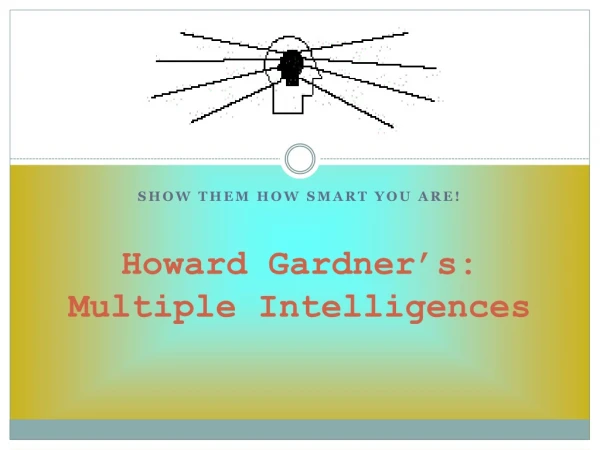
HOWARD GARDNER-Multiple Intelligences: 8 specific intelligences -represent different independent abilities -broadens traditional definition of intelligence -savants: with exceptional skills show intelligence is not single factor http://commons.wikimedia.org/wiki/File:Multipleints.jpg
EMOTIONAL INTELLIGENCE (EQ): -highest IQ not always=success -interpersonal skills: ability to get along and be thoughtful of others -intrapersonal skills: understand self and have self-control, and delay of gratification
ROBERT STERNBERG-Triarchic Theory: 3 types of intelligences Analytical intelligence: traditional abilities Practical intelligence: “street smarts” Creative intelligence: think in new ways
MEASURING INTELLIGENCE: -must try to make intelligence concrete -way to assess mental aptitudes and compare them with others numerically http://upload.wikimedia.org/wikipedia/commons/2/21/Bundesarchiv_Bild_102-11344%2C_Intelligenzpr%C3%BCfung_schulentlassener_M%C3%A4dchen.jpg
ALFRED BINET: -created 1st intelligence test -compulsory public education in France at turn of the 20th century -needed to identify students who would need special attention -created test to measure Mental age: abilities should have for chronological age http://commons.wikimedia.org/wiki/File:Alfred_Binet.jpg
STANFORD-BINET IQ TEST: Louis Terman: professor at Stanford revised Binet’s test IQ=intelligence quotient • IQ= mental agex100 chronological age
WECHSLER INTELLIGENCE SCALES: -most commonly used IQ tests today -measured on deviation IQ -compared to others taking the test -100=average IQ -68%=85-115 -95%=70-130 -99%=55-145 FLYNN EFFECT: Increasing IQ, means must restandardize http://commons.wikimedia.org/wiki/File:Standard_deviation_diagram.svg
NATURE v. NURTURE: -both are important in intelligence Nature: -MZ twins, even separated at birth, have very similar IQs -heritability: extent to which trait is inherited is 50-75% Nurture: Flynn Effect: increasing IQs over 3 generations -school, better nutrition, technology, other environmental factors
BIAS IN TESTING: -racial groups score differently on tests -bias because of differing environmental factors Stereotype threat: anxiety that is created when one is worried that they will confirm a negative stereotype about one’s group