Understanding Cell Specialization: Differences and Functions of Human Cells
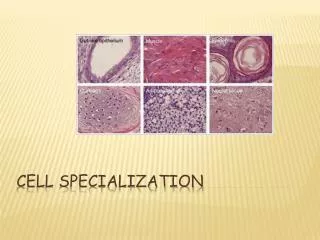
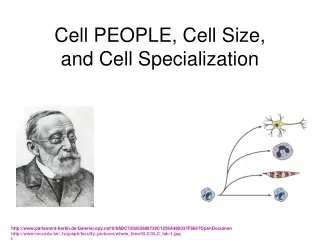
This resource explores the specialization of different human cell types, highlighting key differences between liver cells, muscle cells, and nerve cells. It covers their unique functions: liver cells in metabolism, muscle cells in movement, and neurons in communication. The material also addresses the roles of red blood cells, sensory cells, and skin cells, emphasizing their adaptations for specific tasks. A quiz is included on organelles, cell motility, cell membranes, and specialization, along with homework questions about cell varieties in the human body.

Understanding Cell Specialization: Differences and Functions of Human Cells
E N D
Presentation Transcript
11-14-2011 Cell Specialization • Drill – What are some of the differences between a liver cell and a muscle cell? • Quiz tomorrow on organelles, cell motility, cell membrane, and cell specialization • HW - Worksheet
How many different types of cells are there in the human body?
Neuron • Receives and sends messages • Part of the nervous system • VIDEO • What would neurons have on their membranes? • What organelle would neurons have a lot of?
Sperm and Egg • Reproduction • Sperm uses its ________ to swim to the egg. • What organelle would a sperm cell have a lot of? • VIDEO
Muscle Cells • Stretch and contract to make body movements • Every movement in your body is the result of a muscle cells contracting and another set expanding.
Red Blood Cell • Picks up oxygen from the lungs and delivers it around the body. • Carbon monoxide/cyanide
Cones • Cell in the back of your eye that detects color.
Rods • Cell in the back of your eye that detects light, but isn’t sensitive to color.
Thermosensitive Nerve Cells • Primary function is to detect temperature • Also detect pain • Where are these cells located?
Skin Cells • Provide protection and a barrier to the outside world • The cells on the outside of your skin are dead
Absorptive Cells • These cells absorb nutrients from food. • Where do you think these cells are located?
These are all examples of differentiated cells. What’s an example of an UNdifferentiated type of cell?