Understanding Chemical Reactions and Molar Mass Calculations in Chemistry
160 likes | 271 Views
This comprehensive guide covers essential concepts in chemistry, including the Law of Conservation of Mass, different types of chemical reactions, and the calculation of molar mass. It provides detailed instructions for balancing chemical equations, making atom inventories, and understanding moles and their significance in chemical reactions. The guide also includes a lab experiment concerning the comparison of brand-name and generic medications. Ideal for students looking to enhance their grasp of chemistry fundamentals.


Understanding Chemical Reactions and Molar Mass Calculations in Chemistry
E N D
Presentation Transcript
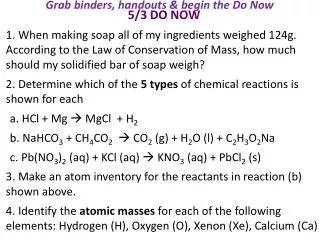
Grab binders, handouts & begin the Do Now 5/3 DO NOW 1. When making soap all of my ingredients weighed 124g. According to the Law of Conservation of Mass, how much should my solidified bar of soap weigh? 2. Determine which of the 5types of chemical reactions is shown for each a. HCl+ Mg àMgCl+ H2 b. NaHCO3+ CH4CO2 CO2 (g) + H2O (l) + C2H3O2Na c. Pb(NO3)2 (aq) + KCl (aq) KNO3 (aq) + PbCl2 (s) 3. Make an atom inventory for the reactants in reaction (b) shown above. 4. Identify the atomicmasses for each of the following elements: Hydrogen (H), Oxygen (O), Xenon (Xe), Calcium (Ca)
Parts of a Chemical Reaction Equation C3H8(aq) + O2(g) 3CO2(g) + 4 H2O(l)
Balancing Reactions Notes Key Point 1: - The law of conservation of mass is represented by balanced reactions # of atoms on the reactants side = # of atoms on the product side
Balancing Reactions Notes Steps to Balancing Reactions: 1. Make an atom inventory of reactants and products 2. Alter coefficients to balance atoms 3. Balance your HO’s last!
Balancing Reactions Notes Directions: Balance the following equations: 1) HCl+ Mg àMgCl+ H2 2) NaHCO3+ CH4CO2 CO2 (g) + H2O (l) + C2H3O2Na 3) Pb(NO3)2 (aq) + KCl (aq) KNO3 (aq) + PbCl2 (s)
The Mole & Molar Mass Notes • What do the following all have in common?
The Mole & Molar Mass Notes Which of the following doesn’t belong? • Dozen • Couple • Few • Baker’s Dozen • Ten
The Mole & Molar Mass Notes Key Point 1: • Mole = a countingunit • 1 mole = 6.02 x 10²³ particles • Tells us how many particles of a compound are actually involved in a reaction 602,000,000,000,000,000,000,000 particles Avogadro’s Number!
Key Point #2: Molar Mass • Molar Mass = the mass of 1 mole of a substance • Tells us what mass of a substance is used in a reaction • Units = grams per mole (g/mol) Example: 1 mole of Magnesum= 24g Molar Mass of Magnesium = 24g/mol
Steps to Calculate Molar Mass of Compounds: • Count out the atoms in the compound • Look up the Molar Mass for each element • Multiply the Molar Mass of each element by the # present in the compound • Sum the Molar Masses
Calculate the Molar Mass of the following 1) NO2 2) SO2 3) C6H12O6 4) (NH4)3PO4
Calculate the Molar Mass of the following 1) NO2 = 46g/mol 2) SO2 = 64g/mol 3) C6H12O6 = 180g/mol 4) (NH4)3PO4 = 149g/mol
Lab 3: Aspirin Lab Question: Are brand name commercial prescription drugs better than generic or homemade prescription drugs? Directions: 20 min… - Determine the WHAT & HOW part of your purpose - Draft your introduction - Read the lab background and complete the hypothesis and Pre-lab questions
HONORS: Mole Calculations Multiply by Avogadro’s Number Moles Particles Divide by Avogadro’s Number
Exit Ticket 4 Directions: You have 5 minutes to complete the Exit Ticket to the best of your ability. You MAY NOT use notes, but you may use a Periodic Table. When finished submit to the class bucket and put up your binder.