Download
1 / 31
310 likes | 400 Views
This guide covers laser characteristics, effects on tissue, electromagnetic spectrum, laser media types, and laser uses across various fields. It includes information on laser hazards, safety protocols, eye and skin protection methods, and environmental controls.

E N D
Lasers Jerri Montelongo Laser Safety Officer Mission Hospital
LASER Light Amplification by the Stimulated Emission of Radiation
Characteristics of Laser Light • Collimated- tightly beamed • Coherent- consistent waves • Monochromatic- one color/spectrum
Lasers Effects on Tissue • Absorbed • Reflected • Diffuse vs. Specular • Transmitted
Other Factors that Influence Effects on Tissue • Circulating blood supply • Specific heat • Thermal conductivity • Color of tissue • Chromophores: Melanin and Hemoglobin • Delivery system
Electromagnetic Spectrum • Visible • 400-700nm • Infrared • 1000-11000nm • Ultraviolet • 150-350nm
Laser Uses • Medical • Commercial • CD players • Computer printers • holograms • Military • Weapon sights • Enemy detection • Industrial • Welding • Cutting metal • Sharpening edges
Types of Lasing Media • Liquid • Tunable Dye • Solid • Nd:Yag • Ruby • Gas • Argon • CO2
Argon • Gas • Visible and Ultraviolet spectrum 488 blue and 514 green • Absorbed in hemoglobin and melanin • Fiber delivery • Orange glasses • Ophthalmology--Retinopathy
CO2 • Carbon Dioxide- Gas • 10,600 nm infrared • Any tissue but not clear liquids • Mirror/arm articulating delivery system • Invisible so uses HeNe beam • Clear Glasses • GYN, ENT, Plastics
Krypton • Gas • 568nm Yellow, 647nm and 676nm red • Blue-green is possible but not commonly used due to weakness of beam. Argon is preferred • Color dependent, absorbed by darker pigments • Free Beam • Glasses are red for 568nm and Blue for 647 and 676 • Plastics and Dermatology: Age spots, veins
Excimer • 193nm, 248nm, 308nm, 351nm • Ultraviolet- Gas • Cold laser because it does not produce heat that can harm surrounding tissue • Pink and Amber glasses • LASIK and PRK , Also used in angioplasty
Holmium YAG • 2100-2140nm • Infrared • Absorbed in water • Pulsing allows delivery • Tears tissue by mechanical destruction • Fiber delivery • Gray Glasses • Urology, Ortho
Nd: YAG • Neodymium: Yttrium Aluminum Garnet Solid • 1064nm- infrared • Invisible, uses HeNe beam • High Absorption in tissue protein • Coagulation • Fiber or free beam • Transmissible through fluid • Light yellow, green and brown glasses • GI bleeds and tumors, vein treatment, hair removal also used in Neuro for tumors and disks, Endometrial ablation
PTP/KTP • Potassium Titanyl Phosphate “K” is potassium on periodic table • 532nm Visible green, solid • Absorbed in hemoglobin and melanin • Intermediate tissue penetration • Cuts on contact coagulates non contact • Fiber • Transmissible through fluid • Orange glasses • Urology
Ruby • 694nm • Solid state, visible light • Blue and blue-green glasses • High energy pulses selectively vaporize tissue • Plastics and dermatology
Tunable Dye • 400-900nm continuous wave • Gas, liquid, and solid state • Multi-tuning wavelengths • Blue to Violet glasses • Dermatology, urology, ophthalmology, Plastics
Laser Classifications Lasers are classified based upon the hazard it presents. Each classification has a standard set of control measures • Class I- no hazard • Class II- Aversion response/Blinking will prevent injury • Class IIIa- blinking can prevent injury unless viewed directly with collecting optics • Class IIIb-beam and reflection can harm if looked at directly including intra-beam viewing of specular reflections • Class IV- extreme hazard to eyes and skin
Laser Hazards • Tissue Injury • Accidental firing and not using safety precautions • Skin Burns and Eye damage • Fire • Sources of ignition • Your role • Preventing Fire • Electrical Shock
Fire • Drapes/Fabrics • Hair • Gases • Plastics • Prep Agents
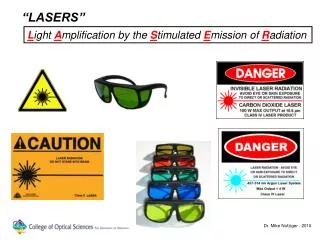
Laser Safety • Eye Protection • Laser Specific lens/color related to laser • Importance of eyewear • Skin Protection • Precautions for employee • Precautions for pt • Airway Protection • Laser Specific Masks • ET tubes • Environmental • Signs • Fire Prevention measures • Prep Solutions • Drapes
Skin protection • Keep body parts out of the beam path • No petroleum products used near laser beams • Wet drapes • Clip hair • Limit laser beam exposure time
Airway Protection • Masks • No green, white or Orange • Do not double mask • Smoke evacuators • Field Suction • Air Exchanges in OR
Environmental Controls • Limited Room Access • Signs • Equipment Controls • Beam enclosures • Experienced Personnel operating and servicing lasers
Bottom Line… • Follow the signs • Rely on guidance from Laser Operator, preceptors are not always correct • Not sure about Glasses or Masks, ASK • Always have saline or water on field