Polynomials
This guide provides a comprehensive overview of polynomials, including definitions and types such as monomials, binomials, and trinomials. Learn how to perform operations on polynomials, including addition, subtraction, multiplication, and division. The document outlines clear steps for identifying like terms, combining coefficients, and presenting answers in standard form. Discover practical examples for better understanding and application of polynomial operations in mathematics.

Polynomials
E N D
Presentation Transcript
Polynomials MM1A2c. E.Q. What is a polynomial and how are the added, subtracted, multiplied, and divided?
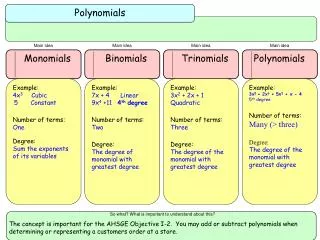
Definitions • Polynomial – an expression formed by adding and subtracting terms of the form axn, where a is any number (coefficient) and n is a whole number. • Examples: • Monomial– an expression in the form of axn, where a is any number and n is a whole number, but there is only one term. • Examples:
Definitions continued • Binomial – an expression in the form of axn, where a is any number and n is a whole number, but there are two terms. • Examples: • Trinomial – an expression in the form of axn, where a is any number and n is a whole number, but there are threeterms. • Examples:
Complete the following 2x3 5x -11 4x7 -9x2 -15x 9x2 8 -22x3 2x7 Match up each monomial in the two columns and explain why you matched them together.
Adding/Subtracting Polynomials • Steps: 1. First identify like terms. 2. Look at only the coefficients to combine terms. 3. After all like terms are combined, put answer in standard form.