Download
1 / 19
190 likes | 297 Views
This comprehensive overview covers key concepts in atomic structure, particularly atomic radii, ionization energy, and electron affinity. Discover how atomic radius is defined and its trends across periods and down groups, influenced by effective nuclear charge and electron shielding. Learn about ionization energy, including the process of ion formation and trends in energy requirements for electron removal. The section on electron affinity explains energy changes associated with gaining electrons and the variation in trends. Explore the properties of cations and anions, as well as valence electrons and electronegativity trends.

E N D
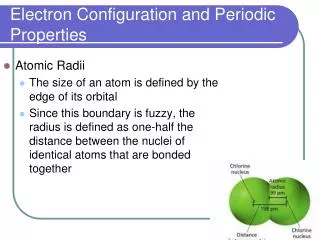
Atomic Radii • Atomic radius – ½ the distance between the nuclei of identical atoms that are bonded together. • Can be difficult to measure
Atomic Radius • Trend: • Decreases across a period • b/c effective nuclear charge • Increases down a group • more E levels / electron shielding
Ionization Energy • You can remove an e- from an atom if enough E is supplied • A + energy = A+ + e- • The A+ is an ion of that atom w/ +1 charge
Ionization Energy • Ion – atom or group of bonded atoms that has a + or – charge • Ionization – any process that results in the formation of an ion • Ionization energy – the E required to remove 1 e- from a neutral atom of an element (aka First Ionization Energy IE1
Ionization Energy • The Trend • Increase across a period • B/c increase effective nuclear charge • Decrease going down the group • e- further out – electron shielding
Removing e- from + ions • If enough E is supplied, you can remove more e- • Called second ionization E, or third ionization E, & so on • 2nd and 3rd are always higher than previous b/c effective nuclear charge
Electron Affinity • Electron Affinity – the E change that occurs when an e- is acquired by a neutral atom • Some give off E = A + e- A- + E • Some require E = A + e- + E = A- • These are unstable and hard to determine
Electron Affinity • Trend: • Increases across a pd (except nob. gas) • Increasing nuclear charge • Decreases down a group • Increase in e- shielding b/c larger atomic radius
Electron Affinity • 2nd e- affinities are always more positive (requires more E) than 1st e- affinities
Ionic Radii • Cation – a positive ion • Made from the loss of an e- • Creates smaller radii • Anion – a negative ion • Addition of 1 or more e- • Creates a larger radii
Ionic Radii • Trend … • Cationic and anionic radii decrease across a pd • B/c increasing nuclear charge • Both increase down a group
Valence Electrons • V.E. – e- available to be lost, gained, or shared in the formation of chemical compounds • Located in incompletely filled main-E levels • For MGE – located in outermost s&p
Electronegativity • e-neg – a measure of the ability of an atom in a chemical compound to attract e- from another atom in the cmpd. • Trend… (NOBLE GASES EXEMPT) • Increase across pd. • Decrease down a group
Properties of the d and f block • Not as straight forward as the others • e- fill in lower E levels for these blocks so some differences occur • Some E levels promote or demote e- to obtain more stability (4s13d5)