Understanding Economic Sectors: From Agriculture to Industry and Services
This overview explores the three main sectors of the economy: primary, secondary, and tertiary. The primary sector focuses on the extraction of raw materials, such as agriculture, mining, and fishing, which prevails in less-developed countries (LDCs) but is on the decline. The secondary sector involves manufacturing and industry, with job shifts from more developed countries (MDCs) to LDCs. Finally, the tertiary sector encompasses services like banking and education, predominantly found in MDCs. The Industrial Revolution catalyzed significant transitions, influencing job markets, urbanization, and overall living standards.


Understanding Economic Sectors: From Agriculture to Industry and Services
E N D
Presentation Transcript
AP Human Geography Industry
Sectors of the Economy • Primary sector (agriculture) • Extraction of raw materials from the Earth • Farming, mining, fishing, forestry • Higher % in LDC’s than MDC’s, decreasing • Secondary sector (industry) • Turn raw materials into useful products • Food processing, manufacture of consumer goods • Decrease in MDC’s; increase in LDC’s • Tertiary sector (services) • Provision of goods and services in exchange for $ • Retail, banking, education, govt, etc. • High % in MDC’s
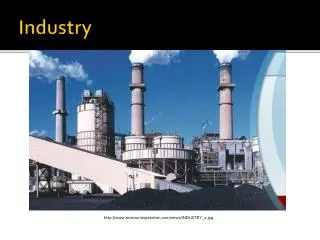
What is Industry? • The manufacturing of goods in a factory • Secondary sector • Historically, major source of jobs in MDC’s. • Shifting from MDC’s to LDC’s • Impact of job loss in MDC’s
The Industrial Revolution • Industrialization- the process by which a country moves from primary to secondary sector. • Begins mid to late 1700’s (18th century) in N. England/ S. Scotland • Diffusion to N. America/ W. Europe by mid-1800’s. • Rest of the world in 20th century. • Led to many social, economic, political changes.
The Industrial Revolution • New technologies (steam engine) increase production…less reliance on animal/human power. • Shift from agricultural to industrial society • People leave rural areas for urban…cities grow rapidly! • Industries impacted by the IR: iron, coal, transportation, textiles, chemicals, food processing. • Overall, standard of living increases as a result of IR
Industry in Europe • Origin of the IR (Great Britain) • United Kingdom • Steel, textiles High tech • Rhine-Ruhr Valley (Germany, Belgium, Netherlands) • Iron, steel, railroads, armaments Port of Rotterdam • Mid-Rhine (Germany/ France) • Consumer markets • Po Basin (Italy) • Textile • NE Spain • Textile, vehicles • Russia
Industry in North America • IR spread to U.S. early to mid- 1800’s • New England (Boston) • Textiles • Middle Atlantic (NYC/ Philly/Baltimore) • Largest American market, entertainment • Mohawk Valley (Buffalo) • Steel • Pittsburgh/ Lake Erie (Pitt/ Cleveland) • Steel • Western Great Lakes (Chicago, Detroit, Gary) • Steel, auto, food • So California (LA) • Clothing, textile, furniture • SE Ontario (Hamilton, ON) • Steel
Industry in East Asia • Japan (1950-60’s) • Originally cut-rate goods…now highest quality • Cars, electronics, precision tools • Tokyo/ Nagasaki/ Osaka • China • Low-cost labor • Textiles/apparel • Household products • Guangdong/ Hong Kong/ Shanghai/ Beijing
Proximity to Inputs • Input---Manufacturing---Retail/Service • Inputs= raw materials/natural resources • Bulk- reducing industry • Plant is located close to inputs if cost of transporting raw materials > finished product to consumer. • Ex. Copper, steel
Proximity to Markets • Bulk gaining industry • Product gains volume/ weight during production • Ex. Fabricated metals, beverage (pop/beer) • Single market manufacturers • Located near only customer • Auto parts plant would be located near assembly plant. • Perishable products • Newspaper, foods