Download
1 / 47
470 likes | 580 Views
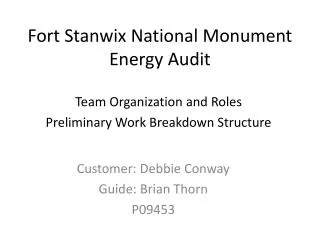
This report documents the energy audit and design review conducted for Fort Stanwix National Monument (FSNM) on February 13, 2009. The primary goal was to reduce energy costs and explore green energy opportunities. The project involved multiple site visits to analyze utility bills, assess building energy use, and evaluate electricity and gas profiles. Key activities included examining the building envelope, identifying energy-consuming devices, and reviewing current mechanical systems. The report outlines the specifications and findings critical for making informed energy conservation decisions.

E N D
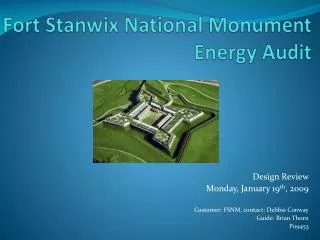
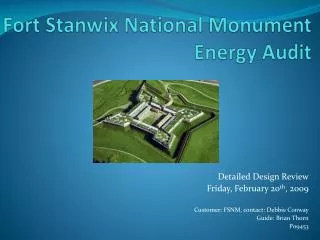
Fort Stanwix National Monument Energy Audit Detailed Design Review Friday, February 13th, 2009 Customer: FSNM, contact: Debbie Conway Guide: Brian Thorn P09453
Customer Needs • Rational for Customer Needs based on: • Project readiness packet • December 2nd phone interview with FSNM – Debbie Conway • December 13th onsite visit with Debbie and Todd • Key statement: reduce current total cost of energy at FSNM to offset the impact of potential ‘green’ energy opportunities and conservation measures
Project Specs – Expectations • Project Specifications: • Attempted traditional approach, it was not inline with an energy audit, not a product • Defined specifications in terms of an energy audit • Project specificationsare the agreed upon expectations of the total energy assessment process and outcome – ‘What is included and captured’ • FSNM specifications are expectations regarding the explicit actions, information, analyses and results that the entire energy assessment project will contain • Definition of the content in the final assessment report • Current Specification is posted on EDGE for review • Debbie Conway singed contract on 1/26/09
Energy Assessment Approach Sections to be covered: • Utility Bill Analysis • Electricity costs & profile, baseline values • Gas costs & profile, baseline values • Energy Use Index & Building Load Factors • Building Envelope & Operations • Heat transfer across envelope • Occupancy distribution • Onsite Visit Details • 1st Visit • 2nd Visit
Utility Analysis – Electricity • NYS Commercial Average price per kWh in cents • Energy Information Administration: • Willett Center charged less than average commercial in NYS Energy consumption graphs available on EDGE
Utility Analysis - Gas • National Propane Gas Association: • Willett Center charged less than average • Cost is $12.18 • 1 Mbtu = 10 therms Energy consumption graphs available on EDGE
Utility Analysis – EUI & Loads Load Factors – gives ratio of average demand to peak demand: indicates a savings if some electric loads are shifted to off-peak hours - Max is 1.0 if no variation in consumption or time of day peaks in demand
Building Envelope Analysis • Determines energy loss through windows, doors and walls based on: • average outside temp, inside temp, insulation, sq ft Window info collected from Todd Gerrard via email
FSNM Visitor Distribution • - Nearly normal distribution • Assuming sign-in distribution of visitors parallels aggregate trend • Open 362 day/year: 9 am – 5 pm
Onsite Visit • 1st site visit, Saturday 12/13 • Refined customer needs, tour, pictures and data collection • Analyze building envelope, ECM potentials • 2nd site visit, Friday 1/23 • Gave project update, refined renewable demo portion • Counted & documented all lights & energy consuming devices (ECDs) • Took building measurement not clear on floor plan • Captured IR images with camera on loan from Dr. Joe Pow • Goal: uncover hidden energy loss
IR Camera images • Gathered interior & exterior pictures, • Outcome: discovered points of interest, but nothing significant • All IR photos available on EDGE: https://edge.rit.edu/content/P09453/public/Willett%20Center%20Infrared%20Pictures Notice how cold exterior windows are in the shade (exterior ~30 F)
Energy Consumption Devices • Any device that consumes electricity • Lighting & HVAC equipment not counted • Total: 106 items used at Willett Center • Wide range of items, most drawing electricity for 8+ hrs/day • Applied toward model & straight energy savings approach Found only 1 energy star product, looking into cost/benefit of going to all energy star
Current Mechanical Systems • HVAC system (additional equipment list available): • 2 Roof Top Units (RTUs) used for solely cooling • RTU1 – runs all year for collections/storage as needed • Innovent Unit: 9000 CFM with mixing box & humidifier • NORTEC Humidifier – electric, collections & storage, erratic humid levels shown by data logger • RTU2 – supplies variable air volumes in exhibit area • Trane Unit: 9200 CFM with variable frequency drive • VFD controls static pressure in air ductwork • 2 Exhaust fans, 1 – restroom & locker rooms, 1 – boilers • Run at 1250 and 400 CFM respectively • It was noted that exhaust fan 1 runs a large portion of the day
Current Mechanical Systems • HVAC system (additional equipment list available): • Boilers – hot water heating system: • 2 Fulton boilers, 300,000 BTUh, always on, varying water temp • Runtime over last 1.5 years: • Boiler-1 2358.0 hrs • Boiler-2 2058.6 hrs • Total hours & cycles: • Boiler 1 8971 hrs, Total Cycles - 58391 • Boiler 2 9509 hrs, Total Cycles – 49035 • Info provided by Todd Gerrard • Plan: investigate newer software versions, 3rd party system wide control systems
Mechanical Systems Controller • Trane Tracer System – control/monitors: • Boilers, Pumps, humidifier, RTU1 & 2 Fans, variable air volume • Controlled from computer terminal on-site • Tracer Summitt Base, Version 17.00 Rev 2, PN: 40201111-V17 • 2 class software – monitor only, monitor/control • Todd Noted: • RTU 1 & 2 are ’self’ controlled including humidifier, setting can not be adjusted by Trane Tracer system • Exhaust fans independent of control system • Control systems ’fight’ each other
Lighting System • The buildings use a range of different bulbs for different purposes. • Most rooms in Willett Center have occupancy sensors. • Documented all lights in Willett Center • Determined wattage • Computed annual kWh consumed
Software Modeling – eQuest • Initially – attempted to purchase expensive, comprehensive software • Distributor did not sell within United States • Alternatives to complex • Contacted Energy Assessment firm for recommendation • eQuest – tool from department of energy • Free • More User friendly interface, decreases learning curve • Fully function building model
eQuest Benefits • Enables ‘What-if’ analyses through implementing ECMs and analyzing effects • Lifecycle cost analysis • Allows different ESCO rates & billing structures • With actual weather and utility data • Base model input using CAD drawing, apply zones in eQuest • Orient building accurately
eQuest Building Creation Wizard • The opening Design Development Wizard: • Project/Site/Utility • Edit Building Shell • Edit Air-Side System • HW Plant Equipment • Build up utilizing these options
eQuest Building Creation Wizard • Design Development Wizard: • Walls, ceilings, doors • Insulation values • Occupancy, loads • HAVC & lighting • Non-HVAC • ECD, pumps • Domestic Hot Water • Temp & air flow settings • Schedule of HVAC & non-HVAC systems • Energy Efficiency • Insulation
eQuest Simulated Performance • Equipped to handle multiple ECMs and a baseline
Latest Model • Electricity and Gas consumption are within 10 % of actual building performance • Next step: move into testing impacts off different adjustments to building
Energy Conservation and Savings Measures and Opportunities • Developed from on site assessment, observation, and calculations and software modeling • Short term: operation & maintenance approach, low cost replacements and or upgrades • Long term: retrofit through replacement, upgrade systems
Implementation Plan • Aspects to include in implementation plan • Cost of new equipment, software, etc, if applicable • Return on investment (ROI) & payback • Timing • Economic Analysis of each ECM, sustainable/green option [Spring Qtr]
ESCO Analysis • Purpose: • review current energy billing structure • Investigate alternative ESCOs • Not able to switch distributor - National Grid • Structure: • Determine all possible energy providers: 9 available • Graded based on survey ranking importance from customer feedback • Goal: • Identify savings/costs of switching ESCOs
Rubric Grading – process behind subjective analysis 1) Three areas were used in the rubric to compare each ESCO to the Willett Center’s current contract with National Grid: • Billing structure • Contract terms • Energy conservation offerings 2) National Grid’s current contract was used as the benchmark for the rubric grading – being assigned an overall score of 5 (therefore an ESCO with a score less than 5 is a worse and greater than 5 a better alternative) Each area was then assigned a weighting according to the importance to the customer: • Billing structure – 52% • Contract terms – 15% • Energy conservation offerings – 33% Each area was then evaluated on a scale of 1-10, with sub-areas determining the subtraction or addition of point. Copy of grading rubric
ESCO Analysis • NIMO – baseline score of 5 • Value > than 5: Relatively better than NIMO • Value > than 5: Relatively worse than NIMO Quantitative analysis: • Purely numerical • Data from months of high-usage used from baseline • Gas and Electric comparison using quoted rates • Second pass will include the additional costs of green options
ESCO Analysis – Electric Savings • For alternative ESCO, assumed for current average variable or fixed rate (factored past data change in energy prices)
ESCO Analysis – Gas Savings • Used current alternative ESCO to compare to past data (factored past data change in energy prices)
Renewable Demo Project • Structure of demo based on customer feedback: • Demo description/setup in Willett Center for visitors • Construct with potential full scale implementation in mind • Collect data for full scale justification • Renewable Energy Demos Considered: • Wind: not conducive to full scale implementation • Solar: previously considered, most viable option • Geothermal: difficult for demo & full scale • Bio-fuel: proximity to bio-fuel stations • Solar Energy selected
Renewable Demo Layout • AC System, non-grid tied powering a load • Load to be determined
Location of System • Digging restrictions on site at FSNM, no pole mount • Roof mounted PV System Willet Center South End
Components • Spoke with Scott Williams of Solar electrics supply: • Quoted Remote Area PV system including: • 100 W Solar PV Array, conduit wiring harness, 25’ output • 2 Solar Array Roof Mounting Structure, SS hardware • MX-69 charge controller (24 to 12 V), 128 day data log • Terminal strip with fusing install inside battery control enclosure • Outdoor batter/control enclosure, vented, lockable, insulated • 150 W inverter installed inside enclosure • Sealed gel cell battery bank 12V 210 AH, maintenance free • System wiring harness, electrical schematics
Renewable Energy Costs • Scott Williams quote (with freight to ROC): $3300 • Ways to reduce this cost – ‘tone’ down the system • Fair price for caliber of system • Real-Time data logger system, as quoted by Lynn Lindsay of Solar Energy Technologies, cost $900 along • More comprehensive then solar supply, but charge controller must be bought separately • Currently , pursuing other vendor quotes, Solar Electronics Supply quote is fairly indicative of costs Quotes available via email, if needed
Renewable Demo Process Planning • Location (facing South) • Closest opening for wiring (conduit) • Outdoor location for box • Locate ground? • Indoor location • Lighting support? • Wire to other light • Wire a flip switch • Getting the panels to the roof • Pulley system?
Installation Process • Interpret electrical schematics • Pull wires through conduit • Get panels and equipment to the roof • Install Panel Mounts • Slide panels in • Set enclosure where desired • Install interior equipment • Determine order in which equipment will be safely plugged in
Equipment needed • Ammeter • Screwdrivers • Wire strippers • Wire cutters • Cardboard (large piece) • Rubber gloves?
PV Large Scale • PON 1050 – Installation of PV by eligible installers • Government buildings • $5000/kW (0 – 25kW), $4000/kW (25kW – 50kW) • System does not have to face South (calculate losses) • Grid connected vs. Battery • ROI (20 years?) • 10 Watts/ft2
Baseline Assessment • Simulation program • Based on DOE-2 free software • LEED • Volunteer government program • Point-based assessment • Self assessment possible • Determine ECMs based on it?
Moving Forward - Spring Quarter • Order Solar System Wk 11 [Winter Quarter] • Determine energy savings per ECM with detailed breakdown • Economic Analysis • Energy Assessment Report • Install Solar System • Installation, maintenance, test plan
Risks • Difficulty of solar system installation • Lead time on Solar system parts • Detailed ECM impacts • eQuest model assumptions • Funding • Proximity to FSNM
References • http://www.eia.doe.gov/cneaf/electricity/epm/table5_6_a.html • http://www.unitconversion.org/energy/therms-to-btus-th-conversion.html • http://www.npga.org/i4a/pages/index.cfm?pageid=914