CS Principles Lesson Writing Guide
This guide outlines essential themes and pedagogical values for creating effective computer science lessons. It emphasizes equity, access, diversity, and engagement through authenticity in real-world learning experiences. Key components include computational thinking, active learning, peer instruction, and reflection. The eight-step framework for constructing a CSP lesson encompasses determining essential knowledge, developing assessments, and ensuring resource availability. By incorporating diverse strategies and evaluating lesson effectiveness, educators can foster an inclusive and engaging computing curriculum.

CS Principles Lesson Writing Guide
E N D
Presentation Transcript
Themes and Values • Equity, Access, Diversity • Creative Engagement • Authenticity – Real World • Active – not passive • Computational Thinking • Appeal through content and pedagogy!
CS P Pedagogy Ideas • Inquiry • Peer Instruction • Paired Work/Programming • Intentional Method • Flipped Model
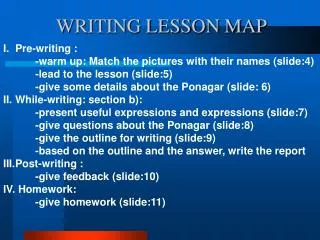
8 Steps to a CSP Lesson • Content: What do they need to know? • Computational thinking: What do they need to learn to do? • Evaluation: How do I confirm they learned it? (Start with end in mind) • Activity: How do they show they learned it? • Instruction: How do they get to the point of being successful? • Resources: What do others need to implement this lesson? • Misc: Wrapping up the lesson doc • Reflection: Was this a good lesson?
Lesson Plan Doc • Title • Time • Prior Knowledge • Overview • Objectives • Guiding Questions • Resources • Lesson Outline • Lesson Instructions • Assessment, Rubrics • Standards
Order of Construction • Standards • Objectives • Guiding Questions • Assessment, Rubrics • Lesson Outline • Lesson Instructions • Resources • Title • Prior Knowledge • Overview • Time
What do they need to know? • Pick Learning Objective, Essential Knowledge Statement, and CSTA standard • Cover many in the same lesson experience • Craft Essential/Guiding Question(s) • What question(s) need to be answered to lead a student to the essential knowledge statements? • Example: • EK 4.1.1.a Sequencing, selection, iteration, and recursion are building blocks of algorithms. • Selection uses a Boolean condition to determine which of two parts of an algorithm are used. • EQ: How are different instructions in an algorithm selected?
What do they need to learn to do? • Computational thinking • Identify the skills/practices • Come from the EK and EQ • Example: • EK 4.1.1.a Sequencing, selection, iteration, and recursion are building blocks of algorithms. • Selection uses a Boolean condition to determine which of two parts of an algorithm are used. • EQ: How are different instructions in an algorithm selected? • P2: Developing computational artifacts • Cc. Use appropriate algorithmic and information- management principles.
How do I confirm they learned? • Create Summative Assessment idea • Examples: Project, Essay, Test (selected response, short answer) • How will they hand in the work? • Labeled screenshots that connect to rubric • Electronically? Self-grade/Peer-reviewed? • Create rubric, exemplar, or answer key first (or in conjunction with handout)
How do they show they learned? • Create the assessment handout • Provide links to extra resources
How do they get to be successful? • Lesson Outline • Lesson Details • Teaching strategies • Activities (Handouts) • Formative Assessment – Checking for understanding
What do others need to teach this? • Materials – Software, websites • Content Support – Links, Docs, Textbook references Title, Summary • Title • Summary – short paragraph
Lesson Evaluation • Can I imagine what the students create? • Do the assessments match the CSP objectives? • Does the lesson appeal to a wide audience? • Is my pedagogy tuned to the content and is it engaging?