
Geometry Angles and Lines: Finding Measures and Relationships
This geometry worksheet helps students practice identifying and calculating angle measures, determining relationships between angles and lines, and evaluating expressions. Students will answer questions involving supplementary angles, parallel lines, and types of angles (acute, right, obtuse). The sheet includes diagrams for visual support and practical problems, enabling learners to find angle measures based on given conditions. It is ideal for reinforcing understanding of basic geometry concepts in a classroom or homework setting.

Geometry Angles and Lines: Finding Measures and Relationships
E N D
Presentation Transcript
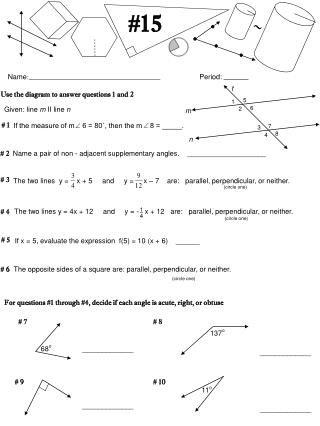
. #15 . . ~ . Name: Period: t Use the diagram to answer questions 1 and 2 Given: line m II line n m 5 1 6 2 If the measure of m 6 = 80˚, then the m 8 = _____. # 1 n 7 3 8 4 Name a pair of non - adjacent supplementary angles. ____________________ # 2 # 3 The two lines y = x + 5 and y = x – 7 are: parallel, perpendicular, or neither. (circle one) 1 4 The two lines y = 4x + 12 and y = - x + 12 are: parallel, perpendicular, or neither. (circle one) # 4 # 5 If x = 5, evaluate the expression f(5) = 10 (x + 6) ______ The opposite sides of a square are: parallel, perpendicular, or neither. (circle one) # 6 For questions #1 through #4, decide if each angle is acute, right, or obtuse # 7 # 8 137o 68o _____________ _____________ # 9 # 10 11o _____________ _____________
. #15b . . ~ . Given the m ABD = 4x + 3˚, and m DBC = 5x + 6˚. Find x, the m ABD, and m DBC. A • D • 11. x = ________ 12. m ABD = _______ 13. m DBC = _______ B • C Use the diagram to answer questions 14 and 21. Given: line m II line n, m 4 = 36˚ and m 16 = 55˚. s t 11 13 1 10 16 12 m 15 4 7 5 6 9 3 8 n 2 14 Find the following: #14 m 2 = _____ m 13 = _____ #18 #19 m 5 = _____ m 1 = _____ #15 m 3 = _____ #20 #16 m 14 = _____ m 11 = _____ #21 m 9 = _____ #17
