Download
1 / 33
330 likes | 481 Views
Dive into the powerful capabilities of Perl for data munging with an in-depth exploration of the essential tools: sort, grep, and map. Learn how to efficiently transform, rank, and extract data from various sources. Discover key techniques to manipulate arrays and hashes, and understand the importance of data representation. This guide features practical examples, challenges, and best practices to enhance your Perl skills. Ideal for intermediate programmers seeking to optimize their data analysis processes and utilize Perl's rich features.

E N D
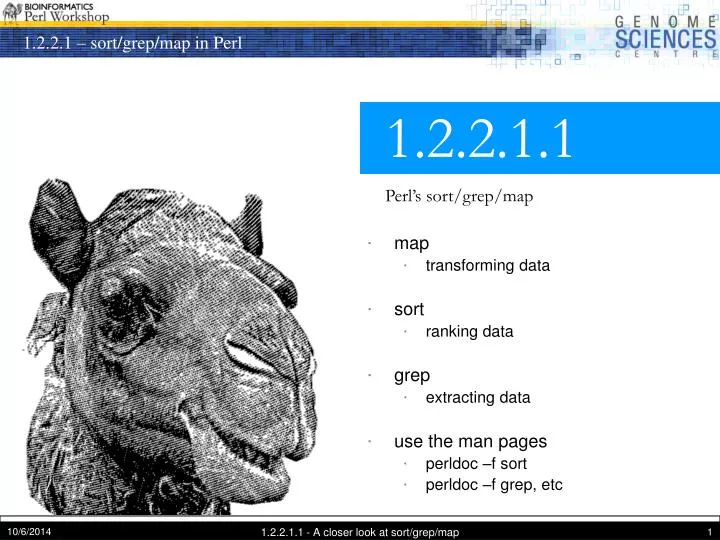
1.2.2.1.1 Perl’s sort/grep/map • map • transforming data • sort • ranking data • grep • extracting data • use the man pages • perldoc –f sort • perldoc –f grep, etc 1.2.2.1.1 - A closer look at sort/grep/map
The Holy Triad of Data Munging • Perl is a potent data munging language • what is data munging? • search through data • transforming data • representing data • ranking data • fetching and dumping data • the “data” can be anything, but you should always think about the representation as independent of interpretation • instead of a list of sequences, think of a list of string • instead of a list of sequence lengths, think of a vector of numbers • then think of what operations you can apply to your representation • different data with the same representation can be munged with the same tools 1.1.2.8.3 - Intermediate Perl - sort/grep/map
Cycle of Data Analysis • you prepare data by • reading data from an external source (e.g. file, web, keyboard, etc) • creating data from a simulated process (e.g. list of random numbers) • you analyze the data by • sorting the data to rank elements according to some feature • sort your random numbers numerically by their value • you select certain data elements • select your random numbers > 0.5 • you transform data elements • square your random numbers • you dump the data by • writing to external source (e.g. file, web, screen, process) 1.1.2.8.3 - Intermediate Perl - sort/grep/map
Brief Example use strict; my $N = 100; # create a list of N random numbers in the range [0,1) my @urds = map {rand()} (1..$N); # extract those random numbers > 0.5 my @big_urds = grep($_ > 0.5, @urds); # square the big urds my @big_square_urds = map {$_*$_} @big_urds; # sort the big square urds my @big_square_sorted_urds = sort {$a $b} @big_square_urds; 1.1.2.8.3 - Intermediate Perl - sort/grep/map
Episode Imap 1.1.2.8.3 - Intermediate Perl - sort/grep/map
Transforming data with map • map is used to transform data by applying the same code to each element of a list • think of f(x) and f(g(x)) – the latter applies f() to the output of g(x) • x :-> g(x), g(x) :-> f(g(x)) • there are two ways to use map • map EXPR, LIST • apply an operator to each list element • map int, @float • map sqrt, @naturals • map length, @strings • map scalar reverse, @strings; • map BLOCK LIST • apply a block of code; list element is available as $_ (alias), return value of block is used to create a new list • map { $_*$_ } @numbers • map { $lookup{$_} } @lookup_keys 1.1.2.8.3 - Intermediate Perl - sort/grep/map
Ways to map and Ways Not to map I’m a C programmer for(my $i=0;$i<$N;$i++) { $urds[$i] = rand(); } I’m a C/Perl programmer for my $idx (0..$N-1) push(@urds,rand()); } I’m trying to forget C for (0..$N-1) { push(@urds,rand) } I’m a Perl programmer my @urds = map rand, (1..$N); 1.1.2.8.3 - Intermediate Perl - sort/grep/map
Map Acts on Array Element Reference • the $_ in map’s block is a reference of an array element • it can be therefore changed in place • this is a side effect that you may not want to experiment with • in the second call to map, elements of @a are altered • $_++ is incrementing a reference, $_, and therefore an element in @a • challenge – what are the values of @a, @b and @c below? my @a = qw(1 2 3); my @c = map { $_++ } @a; # a is now (2,3,4) my @a = qw(1 2 3); my @b = map { $_++ } @a; # what are the values of @a,@b now? my @c = map { ++$_ } @a; # what are the values of @a,@b,@c now? 1.1.2.8.3 - Intermediate Perl - sort/grep/map
Challenge Answer • remember that $_++ is a post-increment operator • returns $_ and then increments $_ • while ++$_ is a pre-increment operator • increments $_ and then returns new value ($_+1) my @a = qw(1 2 3); my @b = map { $_++ } @a; # @a = (2 3 4) # @b = (1 2 3) my @c = map { ++$_ } @a; # @a = (3 4 5) # @c = (3 4 5) 1.1.2.8.3 - Intermediate Perl - sort/grep/map
Common Uses of map • initialize arrays and hashes • array and hash transformation • using map’s side effects is good usage, when called in void context • map flattens lists – it executes the block in a list context my @urds = map rand, (1..$N); my @caps = map { uc($_) . “ “ . length($_) } @strings; my @funky = map { my_transformation($_) } (1..$N); my %hash = map { $_ => my_transformation($_) } @strings; map { $fruit_sizes{$_} ++ } keys %fruit_sizes; map { $_++ } @numbers; @a = map { split(//,$_) } qw(aaa bb c) # returns qw(a a a b b c) @b = map { $_ , map { $_ * $_ } (1..$_) } (1..5); 1.1.2.8.3 - Intermediate Perl - sort/grep/map
Nested Map • what would this return? • inner map returns the first N squares • outer map acts as a loop from 1..5 • 1 : inner map returns (1) • 2 : inner map returns (1,4) • 3 : inner map returns (1,4,9) • 4 : inner map returns (1,4,9,16) • 5 : inner map returns (1,4,9,16,25) • final result is a flattened list @a = map { $_ , map { $_ * $_ } (1..$_) } (1..5); @a = (1,1,4,1,4,9,1,4,9,16,1,4,9,16,25); 1.1.2.8.3 - Intermediate Perl - sort/grep/map
Generating Complex Structures With map • since map generates lists, use it to create lists of complex data structures my @strings = qw(kitten puppy vulture); my @complex = map { [ $_, length($_) ] } @strings; my %complex = map { $_ => [ uc $_, length($_) ] } @strings; @complex %complex [ 'kitten', 6 ], [ 'puppy', 5 ], [ 'vulture', 7 ] 'puppy' => [ 'PUPPY', 5 ], 'vulture' => [ 'VULTURE', 7 ], 'kitten' => [ 'KITTEN', 6 ] 1.1.2.8.3 - Intermediate Perl - sort/grep/map
Distilling Data Structures with map • extract parts of complex data structures with map • don’t forget that values returns all values in a hash • use values instead of pulling values out by iterating over all keys • unless you need the actual key for something my @strings = qw(kitten puppy vulture); my %complex = map { $_ => [ uc $_, length($_) ] } @strings; my @lengths1 = map { $complex{$_}[1] } keys %complex; my @lengths2 = map { $_->[1] } values %complex; %complex 'puppy' => [ 'PUPPY', 5 ], 'vulture' => [ 'VULTURE', 7 ], 'kitten' => [ 'KITTEN', 6 ] 1.1.2.8.3 - Intermediate Perl - sort/grep/map
More Applications of Map • you can use map to iterate over application of any operator, or function • read the first 10 lines from filehandle FILE • challenge: why scalar <F> ? • inside the block of map, the context is an array context • thus, <FILE> is called in an array context • when <FILE> is thus called it returns ALL lines from FILE, as a list • when <FILE> is called in a scalar context, it calls the next line my @lines = map {scalar <FILE>} (1..10); # this is a subtle bug - <FILE> used up after first call my @lines = map {<FILE>} (1..10); # same as my @lines = <FILE>; 1.1.2.8.3 - Intermediate Perl - sort/grep/map
map with regex • recall that inside map’s block, the context is array @a = split(//,”aaaabbbccd”); @b = map { /a/ } @a; # @b = (1 1 1 1) @b = map { /(a)/ } @a; # @b = (a a a a) @c = map { /a/g } @a; # @c = (a a a a) @a = split(//,”aaaabbbccd”); @b = map { s/a/A/ } @a; # @b = (1 1 1 1) # @a = (A A A A b b b c c d) 1.1.2.8.3 - Intermediate Perl - sort/grep/map
Episode IIsort 1.1.2.8.3 - Intermediate Perl - sort/grep/map
Sorting Elements with sort • sorting with sort is one of the many pleasures of using Perl • powerful and simple to use • we talked about sort in the last lecture • sort takes a list and a code reference (or block) • the sort function returns -1, 0 or 1 depending how $a and $b are related • $a and $b are the internal representations of the elements being sorted • they are not lexically scoped (don’t need my) • they are package globals, but no need for use vars qw($a $b) 1.1.2.8.3 - Intermediate Perl - sort/grep/map
and cmp for sorting numerically or ascibetically • for most sorts the spaceship operator and cmp will suffice • if not, create your own sort function # sort numerically using spaceship my @sorted = sort {$a $b} (5,2,3,1,4); # sort ascibetically using cmp my @sorted = sort {$a cmp $b} qw(vulture kitten puppy); # define how to sort - pedantically my $by_num1 = sub { if ($a < $b) { return -1; } elsif ($a == $b) { return 0; } else { return 1; } }; # same thing as $by_num1 my $by_num2 = sub { $a $b }; @sorted = sort $by_num1 (5,2,3,1,4); 1.1.2.8.3 - Intermediate Perl - sort/grep/map
Adjust sort order by exchanging $a and $b • sort order is adjusted by changing the placement of $a and $b in the function • ascending if $a is left of $b • descending if $b is left of $a • sorting can be done by a transformed value of $a, $b • sort strings by their length • sort strings by their reverse # ascending sort {$a $b} @nums; # descending sort {$b $a} @nums; sort {length($a) length($b)} @strings; sort {scalar(reverse $a) scalar(reverse $b)} @strings; 1.1.2.8.3 - Intermediate Perl - sort/grep/map
Sort Can Accept Subroutine Names • sort SUBNAME LIST • define your sort routines separately, then call them • store your functions in a hash sub ascending { $a <=> $b } sort ascending @a; my %f = ( ascending=>sub{$a<=>$b}, descending=>sub{$b<=>$a}, random=>sub{rand()<=>rand()} ); sort { &{$f{descending}} } @a 1.1.2.8.3 - Intermediate Perl - sort/grep/map
Shuffling • what happens if the sorting function does not return a deterministic value? • e.g., sometimes 2<1, sometimes 2=1, sometimes 2>1 • you can shuffle a little, or a lot, by peppering a little randomness into the sort routine # shuffle sort { rand() rand() } @nums; # shuffle sort {$a+$k*rand() $b+$k*rand()} (1..10); k=2 1 2 3 4 5 7 6 8 9 10 k=3 2 1 3 6 5 4 8 7 9 10 k=5 1 3 2 7 4 6 5 8 9 10 k=10 1 2 5 8 4 7 6 3 9 10 1.1.2.8.3 - Intermediate Perl - sort/grep/map
Sorting by Multiple Values • sometimes you want to sort using multiple fields • sort strings by their length, and then asciibetically • ascending by length, but descending asciibetically m ica qk bud d ipqi nehj t yq dcdl e vphx kz bhc pvfu sort { (length($a) length($b)) || ($a cmp $b) } @strings; d e m t kz qk yq bhc bud ica dcdl ipqi nehj pvfu vphx sort { (length($a) length($b)) || ($b cmp $a) } @strings; t m e d yq qk kz ica bud bhc vphx pvfu nehj ipqi dcdl 1.1.2.8.3 - Intermediate Perl - sort/grep/map
Sorting Complex Data Structures • sometimes you want to sort a data structure based on one, or more, of its elements • $a,$b will usually be references to objects within your data structure • sort the hash values • sort the keys using object they point to # sort using first element in value # $a,$b are list references here my @sorted_values = sort { $a->[0] cmp $b->[0] } values %complex; %complex 'puppy' => [ 'PUPPY', 5 ], 'vulture' => [ 'VULTURE', 7 ], 'kitten' => [ 'KITTEN', 6 ] my @sorted_keys = sort { $complex{$a}[0] cmp $complex{$b}[0] } keys %complex; 1.1.2.8.3 - Intermediate Perl - sort/grep/map
Multiple Sorting of Complex Data Structures • %hash here is a hash of lists • ascending sort by length of key followed by descending lexical sort of first value in list • we get a list of sorted keys – %hash is unchanged my @sorted_keys = sort { (length($a) length($b)) || ($hash{$b}->[0] cmp $hash{$a}->[0]) } keys %hash; foreach my $key (@sorted_keys) { my $value = $hash{$key}; ... } 1.1.2.8.3 - Intermediate Perl - sort/grep/map
Slices and Sorting – Perl Factor 5, Captain! • sort can be used very effectively with hash/array slices to transform data structures in place • you sort the array (hash) index (key) • cool, but sometimes tricky to wrap your head around my @nums = (1..10); my @nums_shuffle_2; # shuffle the numbers – explicity shuffle values my @nums_shuffle_1 = sort {rand() rand()} @nums; # shuffle indices in the slice @nums_shuffle_2[ sort { rand() rand() } (0..@nums-1) ] = @nums; nums[ 0 ] = 1 nums[ 1 ] = 2 nums[ 2 ] = 3 . . . nums[ 9 ] = 10 nums[ 0 ] = 1 nums[ 1 ] = 2 nums[ 2 ] = 3 . . . nums[ 9 ] = 10 shuffle values shuffle index 1.1.2.8.3 - Intermediate Perl - sort/grep/map
Application of Slice Sorting • suppose you have a lookup table and some data • %table = (a=>1, b=>2, c=>3, … ) • @data = ( [“a”,”vulture”],[“b”,”kitten”],[“c”,”puppy”],…) • you now want to recompute the lookup table so that key 1 points to the first element in sorted @data (sorted by animal name), key 2 points to the second, and so on. Let’s use lexical sorting. • the sorted data will be • and we want the sorted table to look like this • thus a points to 2, which is the rank of the animal that comes second in @sorted_data # sorted by animal name my @data_sorted = ([“b”,”kitten”],[“c”,”puppy”],[“a”,”vulture”]); my %table = (a=>3, b=>1, c=>2); 1.1.2.8.3 - Intermediate Perl - sort/grep/map
Application of Slice Sorting – cont’d • suppose you have a lookup table and some data • %table = (a=>1, b=>2, c=>3, … ) • @data = ( [“a”,”vulture”],[“b”,”kitten”],[“c”,”puppy”],…) @table{ map { $_->[0] } sort { $a->[1] cmp $b->[2] } @data } = (1..@data) @table{ b c a } = (1,2,3) $table{b} = 1 $table{c} = 2 $table{a} = 3 @table{ map { $_->[0] } sort { $a->[1] cmp $b->[2] } @data } = (1..@data) construct a hash slice with keys as . . . first field from . . . sort by 2nd field of . . . @data 1.1.2.8.3 - Intermediate Perl - sort/grep/map
Schwartzian Transform • used to sort by a temporary value derived from elements in your data structure • we sorted strings by their size like this • which is OK, but if length( ) is expensive, we may wind up calling it a lot • the Schwartzian transform uses a map/sort/map idiom • create a temporary data structure with map • apply sort • extract your original elements with map • another way to mitigate expense of sort routine is the Orcish manoeuvre (|| + cache) • use a lookup table for previously computed values of the sort routine (left as Google exercise) sort { length($a) length($b) } @strings; map {$_->[0]} sort { $a->[1] $b->[1] } map { [ $_, length($_) ] } @strings; 1.1.2.8.3 - Intermediate Perl - sort/grep/map
Episode IIIgrep 1.1.2.8.3 - Intermediate Perl - sort/grep/map
grep is used to extract data • test elements of a list with an expression, usually a regex • grep returns elements which pass the test • like a filter • please never use grep for side effects • you’ll regret it @nums_big = grep( $_ > 10, @nums); # increment all nums > 10 in @nums grep( $_ > 10 && $_++, @nums); 1.1.2.8.3 - Intermediate Perl - sort/grep/map
Hash keys can be grepped • iterate through pertinent values in a hash • follow grep up with a map to transform/extract grepped values my @useful_keys_1 = grep($_ =~ /seq/, keys %hash) my @useful_keys_2 = grep /seq/, keys %hash; my @useful_keys_3 = grep $hash{$_} =~ /aaaa/, keys %hash; my @useful_values = grep /aaaa/, values %hash; map { lc $hash{$_} } grep /seq/, keys %hash; 1.1.2.8.3 - Intermediate Perl - sort/grep/map
More Grepping • extract all strings longer than 5 characters • grep after map • looking through lists # argument to length is assumed to be $_ grep length > 5, @strings; # there is more than one way to do it map { $_->[0] } grep $_->[1] > 5, map { [ $_, length($_) ] } @strings if( grep $_ eq “vulture”, @animals) { # beware – there is a vulture here } else { # run freely my sheep, no vulture here } 1.1.2.8.3 - Intermediate Perl - sort/grep/map
1.1.2.8.2 Introduction to Perl – Session 3 • grep • sort • map • Schwartzian transform • sort slices 1.1.2.8.3 - Intermediate Perl - sort/grep/map