Motion
In this lesson, we explore the principles of motion, examining how an object's position changes relative to a reference point. We discuss the SI system of units for measuring motion, focusing on meters and centimeters. Key concepts include speed calculation, distinguishing between average and instantaneous speed, and the differences between speed and velocity. Additionally, we learn how to illustrate motion through distance vs. time graphs, where a straight line signifies constant speed and a horizontal line indicates no movement.


Motion
E N D
Presentation Transcript
Motion Mrs. Wharton’s Science Class
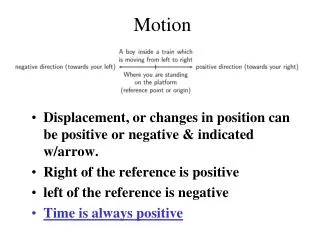
Motion • An object is in motion if it changes position relative to a reference point • Reference Point- is a place or object used for comparison to determine if something is in motion.
Motion measurement • Uses the SI system of units. • Based on the unit 10 • SI unit for length is meter. • Centimeters may also be used
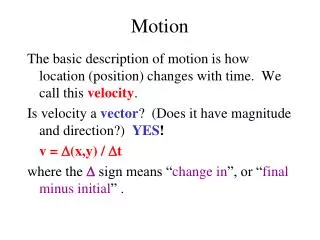
Calculating Speed • Rate- the amount of something that occurs or changes in one unit of time • Speed is a type of rate • If you know the distance an object travels in a certain amount of time you can determine the speed. • Speed- of an object is the distance the objects travels in one unit of time. • S=D/T
Average vs. Instantaneous speed • Average speed- of an object , you divide the total distance traveled by the total time • Instantaneous speed-is the rate it is moving at a given instant.
Speed Vs. Velocity • Speed- tells you how fast it is moving but not in what direction. • Velocity – when you know both the speed and the direction of an object in motion; (speed in a given direction.)
Distance vs. Time Graph You can show the motion of an object on a line graph which you plot distance v time • A straight line represents motion at a constant speed • A horizontal line represents an object that is not moving at all • The steepness of a line’s slope depends on the speed of an object.