Acidity on the half shell
This article explores the alarming effects of ocean acidification caused by CO2 emissions on marine ecosystems, particularly oysters. It explains the chemical processes involved, such as the formation of carbonic acid, and discusses the negative impacts on oyster larvae and hatcheries, notably the failure of the Whiskey Creek Hatchery in Oregon. The piece highlights the importance of maintaining a healthy ocean, the role of upwelling in nutrient distribution, and the ongoing efforts to monitor and address ocean acidity through various programs and research.
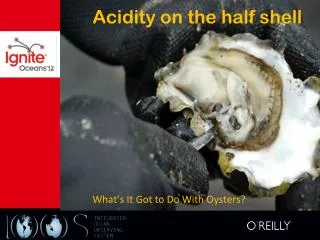

Acidity on the half shell
E N D
Presentation Transcript
Acidity on the half shell What’s It Got to Do With Oysters?
Direct result of CO2 emissions Atmospheric carbon dioxide CO2 (CO2 + H2O) CO2(aq) H2CO3 HCO3– + H+ CO32– + H+ Dissolved carbon dioxide Carbonic acid Bicarbonate Carbonate pH CO32- CO2(aq) HCO3- Primer on ocean acidification
Symptoms of Acidosis Source: Wikipedia
Modeled pH in Surface Waters pH Feely, DoneyandCooley, Oceanography(2009)
Very bad news - for the ocean and me Healthy ocean
Oyster Larvae Credit: Dr. Carolyn Friedman / University of Washington
The Whiskey Creek Hatchery Story Images from Lynn xxx, OSU) Failure of the Pacific Oyster Hatchery at Netarts Bay, Oregon The Whiskey Creek Story Credit: Photos by Lynn Ketchum, OSU
Offshore water displacement due to earth’s rotation Wind Stress Upwelling brings high CO2, low pH, low Ω, low O2 water to surface Upwelling
International OA Coordination Centre established in Monaco during Rio+20 Summit
Core Measurements Temperature Salinity pCO2 (sea, water) pH Dissolved Oxygen CORROSIVE WATER ALERT!
Join us Join us? For more information: NOAA Ocean Acidification Program Libby.Jewett@NOAA.gov