Download
1 / 16
160 likes | 299 Views
This overview delves into the draft process during the Civil War, focusing on the Confederacy's conscription laws and the Union's recruitment strategies from July 1863 to December 1864. We examine key exemptions, the impact of the NYC draft riots, and the role of substitutes. Additionally, we analyze the 1864 presidential election, highlighting Lincoln's challenges against McClellan and Fremont. The discussion also explores whether the Civil War was a total war and covers significant military campaigns, including Sherman’s March to the Sea and the eventual surrender at Appomattox.

E N D
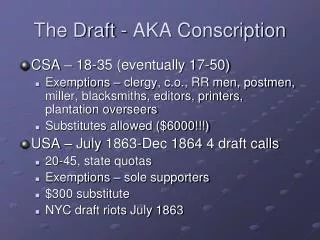
The Draft - AKA Conscription • CSA – 18-35 (eventually 17-50) • Exemptions – clergy, c.o., RR men, postmen, miller, blacksmiths, editors, printers, plantation overseers • Substitutes allowed ($6000!!!) • USA – July 1863-Dec 1864 4 draft calls • 20-45, state quotas • Exemptions – sole supporters • $300 substitute • NYC draft riots July 1863
What will be the main factor in Lincoln’s bid for reelection?
Was the Civil War the first modern war? Yes – Ironclads, subs, repeating weapons, mass mobilization, trench warfare (see WWI)
Was the Civil War the first modern war? No – weapons not new, Napoleonic mobilization, mostly muzzle loading single shot weapons, cavalry
Election of 1864 • Lincoln (Union/Republican) • “I am going to be beaten.” • McClellan (Copperhead/Democrat/Peace) • CSA needs him to win • Leading until… “Atlanta is ours.” • Fremont (harsh re-entry of South)
Was the Civil War a Total War? Yes – mass mobilization, Sherman’s March, target civilians/property, emancipation, massive casualties
Was the Civil War a Total War? No – Civilians not killed indiscriminately, property often protected, no more than 50% of manpower mobilized (US), no mass executions
Sherman’s March to the Sea • May-Dec 1864 • SE through GA, (then N through SC + NC) • Make CSA “sick of war” • “We have devoured the land. To realize what war is, one should follow our tracks.”
Grant in VA • Suffers huge casualties…but inflicts them as well (May-June 1864 65,000 d,w,m) • “He’s a butcher.” • “But he fights!” • Attack, attack, attack • Civilian property is fair game
Election of 1864 • Lincoln wins 55% to 45% of popular vote • Christmas 1864 • Sherman gives Abe Savannah, GA • Spring ’65 – Sherman torches Columbia, SC
Spring 1865 • Lee running from Grant • Davis/CSA burn Richmond, VA
April 9, 1865 • Appomattox Court House, VA • Lee surrenders to Grant
The Numbers* • Confederacy 94,000 KIA 164,000 died from disease 258,000 dead (25,976 died in prisons) ??? WIA Union 138,154 KIA 221,374 died from disease 359,528 dead (30,218 died in prisons) 280,040 WIA
How is the election of 1864 part of the argument against “Lincoln the Dictator” during the Civil War?