Understanding the Fundamental Theorem of Calculus and Substitution Rule in Integration
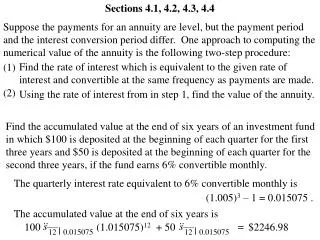
This resource delves into the Fundamental Theorem of Calculus, explaining the concepts of indefinite integrals and net area over the interval [-1,9]. It provides step-by-step examples of evaluating integrals using geometric interpretation and integration techniques. The document emphasizes the importance of substitution in integration, showcasing how to apply the Substitution Rule to solve integrals like ∫x³cos(x⁴ + 2)dx effectively. This guide is essential for mastering calculus fundamentals and enhancing integration skills.

Understanding the Fundamental Theorem of Calculus and Substitution Rule in Integration
E N D
Presentation Transcript
4.3- 4.4 Fundamental Theorem of Calculus Indefinite Integrals
4.5 Substitution Rule
Find x3cos(x4 + 2) dx. Solution: We make the substitution u = x4 + 2 because its differential is du = 4x3 dx, which, apart from the constant factor 4, occurs in the integral. Thus, using x3 dx =du and the Substitution Rule, we have x3cos(x4 + 2) dx = cosudu = cosu du Example:
= sin u + C = sin(x4 + 2)+ C Notice that at the final stage we had to return to the original variable x. Example – Solution cont’d
Evaluate . Solution: Let u = 2x + 1. Then du= 2 dx, so dx = du. So: Example: 4 0