Download
1 / 12
120 likes | 262 Views
The Endangered Species Act (ESA), established in 1973, aims to protect and conserve endangered species and their habitats for present and future generations. With over 1,925 species listed, it provides mechanisms for designating critical habitats and fosters cooperation among landowners, government agencies, and conservation organizations, like the U.S. Fish and Wildlife Service and NOAA Fisheries. Success stories, such as the recovery of the California Condor and the Bald Eagle, demonstrate the effectiveness of the ESA in safeguarding biodiversity.

E N D
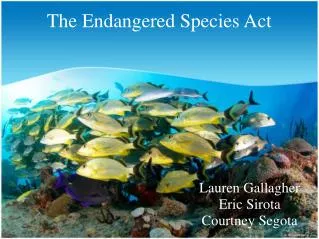
Endangered Species Act By: Kelly Hansard, Kelli Bagwell, and Celeste Ligon
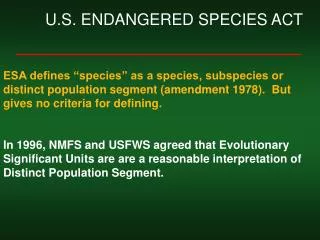
Purpose • The Endangered Species Act (ESA) was established in 1973 to conserve the Nation’s natural heritage for the enjoyment and benefit of current and future generations by conserving species that are in danger of extinction.
History/Authorization of Act • The Endangered Species Act (ESA) was established in 1973 and amended in 1982, 1985 and 1988. • To read the ESA go to http://epw.senate.gov/esa73.pdf
Endangered Species • Total listed- 1,925 species • Examples: Blue Whale, Florida Panther, Jaguar Blue Whale Florida Panther Jaguar
Habitat Conservation • As habitat loss is the primary threat to most endangered species, the ESA of 1973 allowed the FWS and NOAA Fisheries to designate specific areas as protected “critical habitat” zones. • These habitats require all the essential needs of the endangered species. Such lands may be private or public.
Recovery • The process- to provide specific management to ensure that a species is a secure member of its ecosystem • Its achieved by cooperative conservation with private land owners and through incentives provided by the FWS
The Goal of Recovery • Goal: to increase the numbers and improve the management to the point where they can be removed from the endangered list
Successful examples of Recovery • The California Condor • Black-footed Ferret • Peregrine Falcon • Bald Eagle California Condor Black-footed Ferret Peregrine Falcon Bald Eagle
Enforcement/Funding • The U.S Fish and Wildlife Service (FWS) • NOAA (National Oceanic and Atmospheric Administration) Fisheries • Both of these organizations provide enforcement as well as funding
Funding Continued… • The Word Wildlife Fund (WWF) safeguards hundreds of species around the world.
Penalties • There are different degrees of violation with the law. • Most punishable offense: importing, exporting, and trafficking endangered species • Consequences: fines of up to $50,000, imprisonment, or suspension of a license/permit
Bibliography • http://www.worldwildlife.org/species/ • http://en.wikipedia.org/wiki/Endangered_species • http://library.findlaw.com/1999/Jan/1/241467.html