Efficient Heap Implementation: ADT, Operations, and Heapsort Explained
This chapter delves into the Abstract Data Type (ADT) heap, detailing its implementation using arrays and the fundamental operations involved, such as adding and removing entries. The principles of maxheaps are discussed, including the structure of complete binary trees and the comparisons of values within nodes. Creating heaps efficiently through reheapification is emphasized, alongside a thorough explanation of the heapsort algorithm. Relevant algorithms and code snippets are provided, making this content a valuable resource for understanding heaps and their applications in sorting.


Efficient Heap Implementation: ADT, Operations, and Heapsort Explained
E N D
Presentation Transcript
A Heap Implementation Chapter 18
Chapter Contents • Reprise: The ADT Heap • Using an Array to Represent a Heap • Adding an Entry • Removing the Root • Creating a Heap • Heapsort
Reprise: The ADT Heap • A complete binary tree • Nodes contain Comparable objects • In a maxheap • Object in each node ≥ objects in descendants • Note contrast of uses of the word "heap" • The ADT heap • The heap of the operating system from which memory is allocated when new executes
Reprise: The ADT Heap • Interface used for implementation of maxheap public interface MaxHeapInterface{ public void add(Comparable newEntry);public Comparable removeMax();public Comparable getMax();public boolean isEmpty();public int getSize();public void clear();} // end MaxHeapInterface
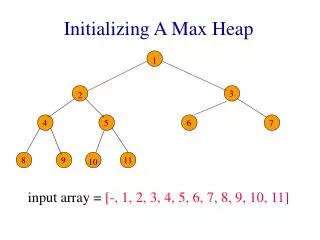
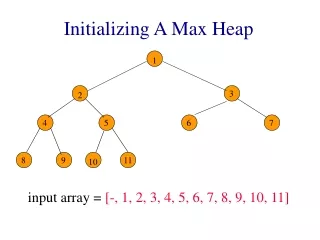
Using an Array to Represent a Heap (a) A complete binary tree with its nodes numbered in level order; (b) its representation as an array.
Using an Array to Represent a Heap • When a binary tree is complete • Can use level-order traversal to store data in consecutive locations of an array • Enables easy location of the data in a node's parent or children • Parent of a node at i is found at i/2(unless i is 1) • Children of node at i found at indices 2i and 2i + 1
Adding an Entry The steps in adding 85 to the maxheap of Figure 1
Adding an Entry • Begin at next available position for a leaf • Follow path from this leaf toward root until find correct position for new entry • As this is done • Move entries from parent to child • Makes room for new entry
Adding an Entry A revision of steps of addEntry to avoid swaps.
Adding an Entry An array representation of the steps in previous slide … continued →
Adding an Entry An array representation of the steps
Adding an Entry • Algorithm for adding new entry to a heap Algorithm add(newEntry)if (the array heap is full)Double the size of the arraynewIndex = index of next available array locationparentIndex = newIndex/2 // index of parent of available locationwhile (newEntry > heap[parentIndex]){ heap[newIndex] = heap[parentIndex] // move parent to available location// update indicesnewIndex = parentIndex parentIndex = newIndex/2} // end while
Removing the Root The steps to remove the entry in the root of the maxheap
Removing the Root • To remove a heap's root • Replace the root with heap's last child • This forms a semiheap • Then use the method reheap • Transforms the semiheap to a heap
Creating a Heap The steps in adding 20, 40, 30, 10, 90, and 70 to a heap.
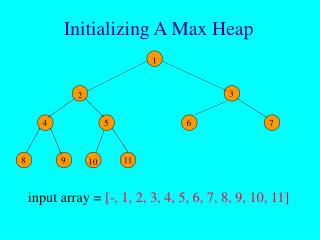
Creating a Heap More efficient to use reheap than to use add The steps in creating a heap by using reheap.
Heapsort • Possible to use a heap to sort an array • Place array items into a maxheap • Then remove them • Items will be in descending order • Place them back into the original array and they will be in order
Heapsort A trace of heapsort (a – c)
Heapsort A trace of heapsort (d – f)
Heapsort A trace of heapsort (g – i)
Heapsort A trace of heapsort (j – l)
Heapsort • Implementation of heapsort public static void heapSort(Comparable[] array, int n){ // create first heapfor (int index = n/2; index >= 0; index--) reheap(array, index, n-1); swap(array, 0, n-1);for (int last = n-2; last > 0; last--) { reheap(array, 0, last); swap(array, 0, last); } // end for} // end heapSor private static void reheap(Comparable[] heap, int first, int last){ < replacing rootIndex with first and lastIndex with last. >. . .} // end reheap Efficiency is O(n log n).