Totalitarianism
After WWI, totalitarian regimes gained control, rejecting liberal values in favor of obedience and mass nationalism. Mussolini's Fascist movement rose in Italy, characterized by militarization, sexism, and propaganda, appealing to veterans by promising stability. As economic turmoil spread through Europe, including hyperinflation in Germany and unemployment during the Great Depression, extremist ideologies flourished. National Socialism gained power, resulting in devastating consequences. This era starkly contrasted with previous democratic principles, demonstrating the dangers of totalitarianism and the suppression of individual rights.

Totalitarianism
E N D
Presentation Transcript
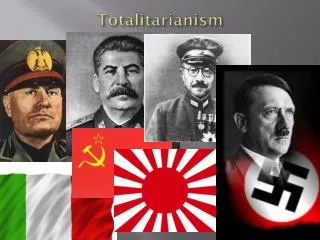
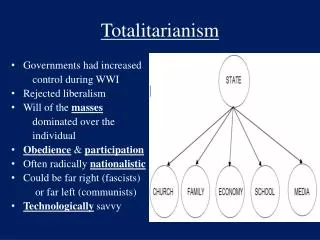
Governments had increased control during WWI Rejected liberalism Will of the masses dominated over the individual Obedience & participation Often radically nationalistic Could be far right (fascists) or far left (communists) Technologically savvy Totalitarianism
1919: verge of bankruptcy high inflation & unemployment unhappy with terms of Versailles Mussolini’s Fascio di Combattimento appealed to veterans; used brute force & nationalistic rhetoric 1922: march on Rome w/ his Black Shirts Il Duce Italy
Nationalistic ideology Militarization Rampant sexism Education; massive indoctrination & propaganda Loyal to landowners & industrialists; NOT the lower classes Secret Police; censorship Lateran Accords Fascism in Italy
State “Corporatism” 1926: National Council of Corporations created • Guilds of employers & employees established to manage the economy • Supported by small capitalists & the middle class; all felt threatened by the rise of Socialists • Goal harmonize the interests of workers, managers and the state by abolishing class warfare. • Reality This system hampered technological progress and destroyed workers’ rights.
1919-24: Versailles’ punishments Ruhr, hyperinflation & unemployment National Socialism Beer Hall Putsch 1924-29: stability & prosperity Nazis organize & plan 1929-33: The Great Depression Nazis come to power Hyperinflation in Germany Weimar Germany
1931: King Alfonso XIII abdicated; a Popular Front formed 1936-39: Spanish Civil War Nationalists vs. Republicans Franco’s Nationalists win “dress rehearsal for WWII” Picasso’s Guernica Republican At the Instant of Death Spanish Civil War
France: 1920s: Raymond Poincare Ruhr Valley fiasco Cartel of the Left 1936: Leon Blum’s Popular Front; “France’s New Deal” Great Britain: massive unemployment Keynesian Economics Massive Unemployment The Democracies & Depression
Culture Between the Wars Mass Media: radio & cinema • BBC • Goebbels’ The Triumph of Will Art: surrealism & modern art • Dali’s Persistence of Memory • Dadaism Literature: “stream of consciousness” Dali’s Persistence of Memory