Download
1 / 34
340 likes | 474 Views
Discover the vastness of stars and stellar systems within our universe. This comprehensive overview covers the electromagnetic spectrum, including different types of visible spectra such as continuous and emission spectra. Learn about the Sun's structure, the intricacies of atomic absorption and emission processes, and essential physical laws governing motion and gravity. Additionally, investigate the absolute and apparent magnitudes of stars, their classifications, and the significance of variable stars like Cepheid variables in measuring cosmic distances.

E N D
Types of Visible Spectra • Continuous Spectrum • Emission Spectrum
Continuous Spectra • A. Bremstrahlung radiation (“braking accel”)http://en.wikipedia.org/wiki/Bremsstrahlunghttps://video.search.yahoo.com/search/video;_ylt=A0SO81ROPOFTNmIAWPhXNyoA;_ylu=X3oDMTB0YnFsaDgwBHNlYwNzYwRjb2xvA2dxMQR2dGlkA1ZJUDIyNl8x?p=bremsstrahlung+radiation+animation
slide continued… • B. Thermal radiation (light bulbs and stars…)
slide continued… • Stefan-Boltzmann and Wien’s Radiation Lawshttp://csep10.phys.utk.edu/astr162/lect/light/radiation.html
Emission Spectra • Hydrogen atom classical orbits
slide continued… • Hydrogen atom energy level diagram
Newton’s Laws of Motion • Property of inertia • F = ma • Action-Reaction ---> F12 = -F21
Kepler’s Laws of Planetary Motion • http://hyperphysics.phy-astr.gsu.edu/hbase/kepler.html
***STARS*** • How many? • Lots of them … • The average human body has 50 trillion cells! • The Milky Way has about 400 trillion stars! • And there are perhaps 200 billion galaxies(large and small)!! • So, how many stars? > 1024!!! • 10 moles of stars --- (AWESOME)4
So, how do these cosmological cells do their thing • First, an average, garden-variety star: the SUN
The Sun • Is 1.5 x 10¹¹ m (93 x 106 mi) from the earth • Has a radius of 7 x 10⁸ m (440,000 miles --- earth radius is 4000 miles) • Has a mass of 2 x 1030 kg (earth is 5 x 1024 kg)
the sun continued… • Has an effective surface temp of 5800 K • Has an intensity (power output/unit area) ofσT4 = 5.67 x 10-8 x (5800)4 = 6.42 x 10⁷ w/m2 • Has a luminosity (power output in watts) of σT4 (4πR2) = 5.67 x 10-8 x (5800)4 x 3.14 x (6.98 x 108)2 = 3.85 x 1026 watts (J/s) • Power/area reaching the earth (in 8.3 min) is1340 w/m2 at upper atm.
The Core of the Sun • Energy supplied by nuclear fusion of protons(E = mc2) • “Burns” approximately 4.3 x 10⁹ kg of protons/sec (3.85 x 1026 J/s) • Temperature about 15 million Kelvin • Radius approximately 200,000 km
Star Brightness and the Magnitude Scale • The apparent magnitude of a star is a measure of its brightness as seen by the eye. • The brighter the star, the lower the magnitude • Historically, apparent magnitudes ranged from 1 to 6 (with 1 being the brightest and 6 being the dimmest) • Today, the apparent magnitude scale ranges from negative values to values > 6.
apparent magnitudes continued… • In modern times, the scale was modified such that the brightness of a 1-magnitude star was 100 times > than that of a 6-magnitude star. • Hence, a change in magnitude of 1 (e.g., from 2 to 3) corresponds to a change in brightness of 2.516 (since 2.5125 = 100, where 5 = 6 – 1 is the total magnitude difference between m = 1 and m = 6)
apparent magnitude continued… • Examples of apparent magnitudes • Barely visible to the naked eye: 5-6th mag. • mSun = -26.7 mVenus = -4.6 mSirius = -1.46 • mAlgol = +2.09 mBetelgeuse = 0.3 to 1.2
The Inverse-Square Law of Light Inverse-Square LawThe brightness of a point source of light varies inversely with the square of the distance between an observer and the source of light.That is, brightness varies as 1/r2.Hence, the brightness of a receding car’s tail lights is ¼ as great at 2 blocks down the street as when the car is 1 block down the street.
Absolute Magnitudes • The absolute magnitude, M, of a star is a measure of its intrinsic brightness (luminosity) • It is numerically the same that the apparent magnitude of a star would have if it were located a distance of 10 pc from the earth. (1 pc = 3.26 light years = 1.96 x 10¹³ miles) • Hence, Barnard’s star, with an apparent magnitude of m = 9 (at a distance of about 6 LY) has an absolute magnitude of M = 13.2. • Absolute magnitudes allow true comparison of star brightnesses
Variable Stars • Intrinsically varying stars are those whose magnitudes change periodically; they are known as pulsators since their brightness pulsates (both size and temp of the star varies) • Cepheid variables, discovered by Henrietta Leavett, are among the most valuable classes of variable stars.
Cepheids continued… • Yellow supergiant stars with F6 – K2 classification • Mass range: 4MSun to 20 MSun • Luminosity: up to 105LSun • Radii change by up to 25% during pulsations(for longer periods)
Cepheid variables continued… • Cepheid variable LIGHT CURVE
Cepheids continued… • Light curve for Cepheid star V1 in Galaxy M31
Cepheids as Standard Candles • Due to the precise relation between the luminosity and period of Cepheid variables, they can be used to determine distances in space. • Based on the apparent magnitude of an observed Cepheid, the relation between apparent and absolute magnitudes can be used to calculate the distance to the variable.
Distance calculations… • Formula for calculating distance d to a Cepheid based on direct measurement of its apparent magnitude m and determination of its absolution magnitude M from its period-luminosity relation.m – M = 5 Log(d) -5
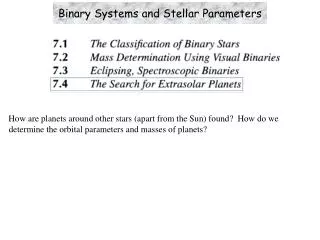
Extrinsic Variable StarsEclipsing Binary Stars • http://astro.unl.edu/naap/ebs/animations/ebs.html • http://www.astro.cornell.edu/academics/courses/astro201/roche_lobe.htm