Implementing a Distance-Vector Routing Protocol with RIPRouter Class
This project involves the development of a RIPRouter class to implement the Routing Information Protocol (RIP). The core functionalities include using hop-count as a distance metric, handling implicit withdrawals, and incorporating the Split Horizon technique. Key implementation points cover route establishment, processing distance-vector updates, and determining when to send updates without incurring penalties. You'll have the freedom to design the data structures for storing routing information. Additional components include a simulator for network topology linking and a visualizer (NetVis) for monitoring packet movement.

Implementing a Distance-Vector Routing Protocol with RIPRouter Class
E N D
Presentation Transcript
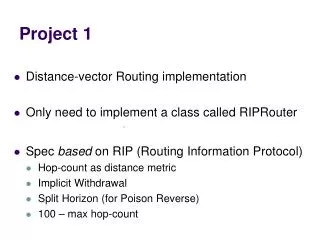
Project 1 • Distance-vector Routing implementation • Only need to implement a class called RIPRouter • Spec based on RIP (Routing Information Protocol) • Hop-count as distance metric • Implicit Withdrawal • Split Horizon (for Poison Reverse) • 100 – max hop-count
Key Implementation Pointers • Route establishment • Centered around distance-vector updates • How to process an update. • When to send new updates? (Penalty if you send too many) • What should the update look like? • Packet Forwarding • Select the next hop based on forwarding table. • Freedom to construct appropriate data structure to store routing information.
Provided Code • Simulator that can link up hosts and your RIPRouters in different topologies and forward packets. • Refer to the simulator guide • A visualizer (NetVis) where you can see the topology and packets.
Extra Credits (maximum 2 out of 3) • #Routing Updates • Link Weights and SmartDV • Can you be smarter about processing DV updates? • Link State implementation and analysis
Logistics • GSIs: Kaifei, Radhika and Gautam • Additional OH for help with the project – will be announced on Piazza • Due October 10, 2013 at midnight. • Submit through instructional machines ‘project1’.