Download
1 / 1
10 likes | 127 Views
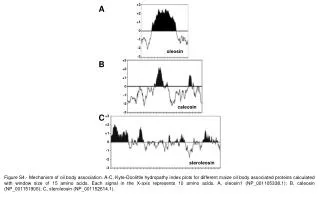
This research explores the mechanism of oil body association in maize through the analysis of oil body-associated proteins: oleosin, caleosin, and steroleosin. Using the Kyte-Doolittle hydropathy index with a window size of 15 amino acids, we examine the hydropathy profiles of these proteins. Each signal on the X-axis corresponds to a segment of 10 amino acids, providing insights into the hydrophobic and hydrophilic properties that facilitate the formation and stability of oil bodies. The findings enhance our understanding of oil storage in plant tissues.

E N D
A oleosin B caleosin C steroleosin Figure S4.- Mechanism of oil body association. A-C, Kyte-Doolittle hydropathy index plots for different maize oil body associated proteins calculated with window size of 15 amino acids. Each signal in the X-axis represents 10 amino acids. A, oleosin1 (NP_001105338.1); B, caleosin (NP_001151906); C, steroleosin (NP_001152614.1). +3 +3 +3 +2 +2 +2 +1 +1 +1 0 0 0 -1 -1 -1 -2 -2 -2 -3 -3 -3