Kinetic Molecular Theory
110 likes | 381 Views
The Kinetic Molecular Theory explains the behavior of gases, emphasizing that particles are always in motion. The individual particle volume is negligible, and their collisions with container walls create gas pressure. All gases have the same average kinetic energy at a given temperature, leading to unique behaviors such as expansion, low density, and fluidity. The theory also encompasses diffusion—the mixing of gases, which occurs faster with increased temperature and smaller molecules. Understanding these principles is crucial for applications like gas separation and purification processes.


Kinetic Molecular Theory
E N D
Presentation Transcript
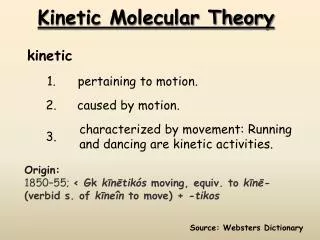
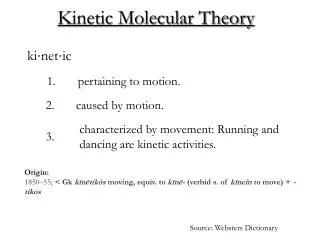
Kinetic Molecular Theory ki⋅net⋅ic Origin: 1850–55; < Gk kīnētikós moving, equiv. to kīnē- (verbid s. of kīneîn to move) + -tikos Source: Websters Dictionary
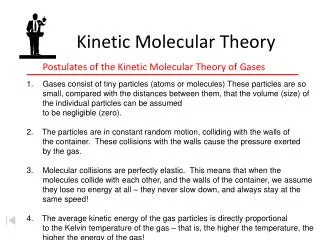
Particles of matter are ALWAYS in motion Volume of individual particles is zero. Collisions of particles with container walls cause the pressure exerted by gas. Particles exert no forces on each other. Average kinetic energy is proportional to Kelvin temperature of a gas. Kinetic Molecular Theory
Kinetic Energy of Gas Particles At the same conditions of temperature, all gases have the same average kinetic energy. m = mass v = velocity At the same temperature, small molecules move FASTER than large molecules
Gases expand to fill their containers Gases are fluid – they flow Gases have low density 1/1000 the density of the equivalent liquid or solid Gases are compressible Gases effuse and diffuse The Nature of Gases
Diffusion • Diffusion describes the mixing of gases. The rate of diffusion is the rate of gas mixing. • Diffusion is the result of random movement of gas molecules • The rate of diffusion increases with temperature • Small molecules diffuse faster than large molecules
Graham’s Law of Diffusion M1 = Molar Mass of gas 1 M2 = Molar Mass of gas 2