Upper-Body Dynamic Stability Assessment in Stroke Patients Along Body Axes
10 likes | 78 Views
Study on acceleration RMS and harmonic ratio parameters in high, medium, and low functional groups during walking post-stroke.


Upper-Body Dynamic Stability Assessment in Stroke Patients Along Body Axes
E N D
Presentation Transcript
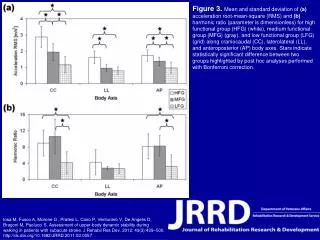
Figure 3. Mean and standard deviation of (a) acceleration root-mean-square (RMS) and (b) harmonic ratio (parameter is dimensionless) for high functional group (HFG) (white), medium functional group (MFG) (gray), and low functional group (LFG) (grid) along craniocaudal (CC), laterolateral (LL), and anteroposterior (AP) body axes. Stars indicate statistically significant difference between two groups highlighted by post hoc analyses performed with Bonferroni correction. Iosa M, Fusco A, Morone G , Pratesi L, Coiro P, Venturiero V, De Angelis D, Bragoni M, Paolucci S. Assessment of upper-body dynamic stability during walking in patients with subacute stroke. J Rehabil Res Dev. 2012; 49(3):439–500.http://dx.doi.org/10.1682/JRRD.2011.03.0057