Download
1 / 11
110 likes | 210 Views
Learn how to craft an excellent essay by mastering key elements including the title, introduction, thesis statement, body paragraphs, and conclusion. This guide provides essential tips and strategies for creating impactful and cohesive essays.

E N D
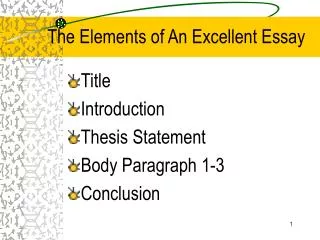
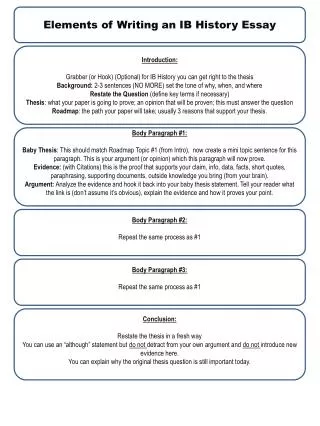
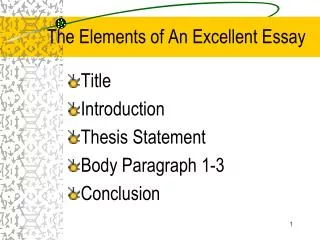
The Elements of An Excellent Essay • Title • Introduction • Thesis Statement • Body Paragraph 1-3 • Conclusion
Introduction • Also called the introductory paragraph. • The first paragraph in an essay. • It includes the thesis, always at the end of the paragraph. • Begin with a sentence that captures the reader’s attention • Give background information on the topic • Enhance the paragraph with an interesting example, • Surprising statistic, or other thought-provoking item • Include the thesis statement
Thesis • States the main idea of the essay • More general than the supporting material • Should mention the specific main point of each of the body paragraphs
Thesis • A sentence with a subject and opinion. • (opinion = commentary) • This comes in your introductory paragraph and always at the end.
Writing a Thesis • A thesis is a general sentence with a subject and an opinion (commentary), and three prongs. • Example: Australia is the best country for a vacation because it has kangaroos, beaches, and shrimp on the bobby. • In this sentence, Australia is the subject. • The rest of the sentence tells the writer’s opinion, or commentary, about it—that it’s the best country for a vacation, and three specific categories (prongs) to tell why.
Body Paragraph • Middle paragraph in an essay. • It develops a point you want to make that supports your thesis. • Begin with a topic sentence that states the main point of the paragraph and relates it to the appropriate prong in the thesis statement • Fill with well-organized evidence, examples, quotations, comparisons, analogies, and/or narration – THEN ANALYZE EACH ITEM TWO TIMES - EAA • Should end with a concluding/transitional sentence
Concrete Details ~ CD • Specific details that form the backbone, skeleton, framework, or core of your body paragraphs. • Synonyms for concrete detail include facts, specifics, examples, descriptions, illustrations, support, proof, supporting evidence, quotations, paraphrasing, or plot references.
Body Paragraph 2-3 • Begin with a topic sentence that states the main point of the paragraph and relates it to appropriate prong in the thesis statement • Fill with well-organized evidence, examples, quotations, comparisons, analogies, and/or narration - THEN ANALYZE EACH ITEM TWO TIMES – EAA • Should end with a concluding/transitional sentence • REPEAT EXACTLY AS BODY PARAGRAPH #1
Conclusion • Also called the concluding paragraph. • The last paragraph in your essay. • It could sum up your ideas . . . • …reflect on what you said in your essay, • …give more commentary about your subject, • …or give a personal statement about the subject.
Conclusion (cont.) • Your conclusion is ALL commentary and does NOT include concrete detail. • It does NOT repeat key words from your paper and especially NOT from your thesis and introductory paragraphs. • It gives a finished feeling to your whole essay.
Conclusion (cont.) • May pose a question for future thought (but be sure it is VERY good) or suggest a course of action • Include a detail or example from the introduction to “tie up” the essay. • End with a strong image or a bit of wit.