Understanding Children's Perception of Pictures: A Study of Ages 3-4
10 likes | 141 Views
This study by Thomas, Nye, and Robinson (1993) explores how children aged 3-4 perceive pictures. It examines whether they can distinguish between a picture as a representation of an object (e.g., a cat) and as an object in its own right. Through four experiments, the authors assess if children can treat pictures transparently, revealing their tendency to focus on the referent rather than the picture itself. The findings indicate that many children may struggle to conceptualize the dual nature of pictures, demonstrating significant implications for child development and education.


Understanding Children's Perception of Pictures: A Study of Ages 3-4
E N D
Presentation Transcript
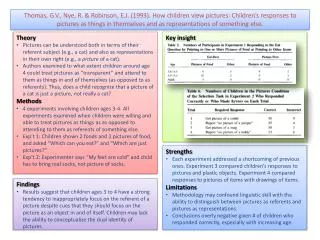
Thomas, G.V., Nye, R. & Robinson, E.J. (1993). How children view pictures: Children’s responses to pictures as things in themselves and as representations of something else. Key insight Theory • Pictures can be understood both in terms of their referent subject (e.g., a cat) and also as representations in their own right (e.g., a picture of a cat). • Authors examined to what extent children around age 4 could treat pictures as “transparent” and attend to them as things in and of themselves (as opposed to as referents). Thus, does a child recognize that a picture of a cat is just a picture, not really a cat? Methods • 4 experiments involving children ages 3-4. All experiments examined when children were willing and able to treat pictures as things as as opposed to attending to them as referents of something else. • Exp’t 1: Children shown 2 foods and 2 pictures of food, and asked “Which can you eat?” and “Which are just pictures?” • Exp’t 2: Experimenter says “My feet are cold” and child has to bring real socks, not picture of socks. Strengths • Each experiment addressed a shortcoming of previous ones. Experiment 3 compared children’s responses to pictures and plastic objects. Experiment 4 compared responses to pictures of items with drawings of items. • Limitations • Methodology may confound linguistic skill with the ability to distinguish between pictures as referents and pictures as representations. • Conclusions overly negative given # of children who responded correctly, especially with increasing age. • Findings • Results suggest that children ages 3 to 4 have a strong tendency to inappropriately focus on the referent of a picture despite cues that they should focus on the picture as an object in and of itself. Children may lack the ability to conceptualize the dual identity of pictures.