Download

1 / 8
90 likes | 205 Views
This fact file provides an introduction to fractions, explaining their components – the numerator and the denominator. A fraction measures part of a whole and can be expressed as a number divided by another number or as a decimal. Learn about proper and improper fractions, mixed fractions, and equivalent fractions with easy-to-understand examples. Additionally, discover how to add fractions with like and unlike denominators. Perfect for anyone looking to deepen their understanding of fractions in mathematics!

E N D
Fractions This is my little fact file on fractions!
What is a Fraction? A fraction is a way of measuring part of a whole. It is made up of 2 parts, called the Numerator and the Denominator. I shall explain what these are if you click on the screen!
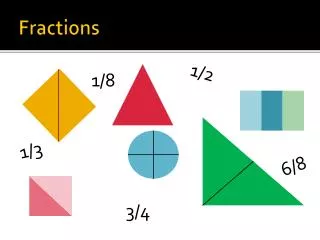
Numerator The numerator is the top number of a fraction. It shows how many equal parts are required. For example: ¼ = 1 divided by 4 (the numerator is 1) which means 1 part of something that’s split into 4 equal pieces!
Denominator The denominator is the bottom number of a fraction. It shows how many equal parts the object is divided into. For example: ¾ = 4 equal parts altogether but only 3 of them are being used!
How to represent a Fraction Fractions can be written as a number divided by another number e.g. ½, ¼ Or as a decimal e.g. 0.5, 0.25
Improper and Proper Fractions Improper Fractions A Proper Fraction is one that has a smaller numerator than denominator e.g. ½, ¼, ¾ An Improper Fraction is one that has a larger numerator than denominator e.g. 6/4, 9/7, 5/3 These can also be represented as Mixed Fractions e.g. 6/4 = 1½, 9/7 = 12/7, 5/3 = 12/3,
Equivalent Fractions Equivalent Fractions are those that look different but mean the same e.g. ½ = 2/4 = 3/6 = 4/8 = 5/10 OR 1/3 = 2/6 = 3/9 = 4/12 = 5/15 OR 24/16 = 3/2 = 1½
Adding Fractions Fractions can be added together. If the denominator is the same for all parts then it is simply a case of adding the numerators together e.g. ¼ + 2/4 = ¾ If the denominator is different then you must try to use equivalent fractions to change the parts into the same denominator e.g.½ + ¼ = 2/4 +¼ = ¾