
Three-Dimensional Spinal Range of Motion Differences in Axial Rotation: Dominant vs. Nondominant
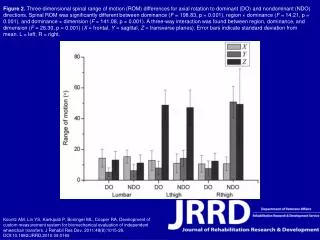
This study investigates the three-dimensional spinal range of motion (ROM) differences during axial rotation towards dominant (DO) and nondominant (NDO) directions. Significant differences were observed in spinal ROM based on dominance (F=198.83, p=0.001), as well as in interactions between region and dominance (F=14.21, p=0.001) and dominance and dimension (F=141.08, p=0.001). A three-way interaction involving region, dominance, and dimension was also significant (F=26.30, p=0.001).

Three-Dimensional Spinal Range of Motion Differences in Axial Rotation: Dominant vs. Nondominant
E N D
Presentation Transcript
Figure 2. Three-dimensional spinal range of motion (ROM) differences for axial rotation to dominant (DO) and nondominant (NDO) directions. Spinal ROM was significantly different between dominance (F = 198.83, p = 0.001), region × dominance (F = 14.21, p = 0.001), and dominance × dimension (F = 141.08, p = 0.001). A three-way interaction was found between region, dominance, and dimension (F = 26.30, p = 0.001) (X = frontal, Y = sagittal, Z = transverse planes). Error bars indicate standard deviation from mean. L = left, R = right. Koontz AM, Lin YS, Kankipati P, Boninger ML, Cooper RA. Development of custom measurement system for biomechanical evaluation of independent wheelchair transfers. J Rehabil Res Dev. 2011;48(8):1015-28.DOI:10.1682/JRRD.2010.09.0169