Understanding Geologic Time: From Eons to Epochs
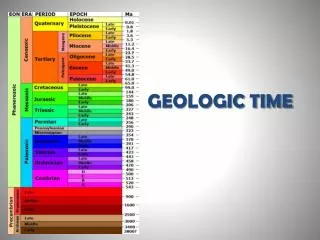
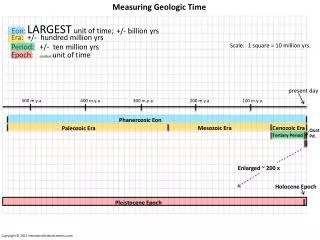
Geologic time is measured by large units, with eons being the longest, spanning billions of years. This timeline is divided into eras, each lasting hundreds of millions of years, and further into periods, with durations around tens of millions. The smallest units are epochs, which represent the most recent segments of time, such as the Holocene and Pleistocene epochs, alongside significant eons like the Phanerozoic. This overview outlines the framework used to understand Earth's history, depicting the evolution of life and significant geological events over time.

Understanding Geologic Time: From Eons to Epochs
E N D
Presentation Transcript
Measuring Geologic Time LARGEST unit of time; Eon: +/- billion yrs Era: +/- hundred million yrs Scale: 1 square = 10 million yrs. Period: +/- ten million yrs Epoch: smallest unit of time present day 500 m.y.a. 400 m.y.a. 300 m.y.a. 200 m.y.a. 100 m.y.a. Phanerozoic Eon Mesozoic Era Cenozoic Era Paleozoic Era Quat. Pd. Tertiary Period Enlarged ~ 200 x Holocene Epoch Pleistocene Epoch