Understanding Severe Thunderstorms, Tornadoes, and Hurricanes: Safety and Impact
This lesson explores severe weather phenomena including thunderstorms, tornadoes, and hurricanes. Thunderstorms are characterized by rain, strong winds, lightning, and thunder, primarily occurring along cold fronts with warm, moist air and unstable conditions. Tornadoes pose significant threats with their destructive wind speeds, while hurricanes develop over tropical oceans, bringing intense winds and flooding. The lesson emphasizes the dangers associated with these natural events and provides essential safety tips to mitigate risks during severe weather situations.

Understanding Severe Thunderstorms, Tornadoes, and Hurricanes: Safety and Impact
E N D
Presentation Transcript
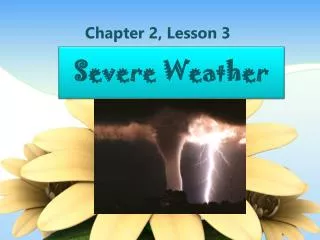
Severe Weather Chapter 2, Lesson 3
Thunderstorms It is a heavy storm that consists of rain, strong winds, lightning, and thunder. Thunderstorms occur along cold fronts. The two atmospheric conditions required to produced thunderstorms are: 1. Warm and moist air 2. Unstable conditions “surrounding air is colder than the rising air mass”
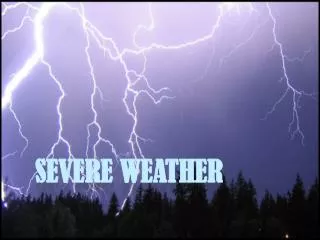
Lightning It is an electric discharge that occurs between two oppositely charged surfaces. 2 3 1
lightning • When lightning strikes, energy is released. • Thunder is the sound that results from the rapid expansion of air along lightning strike.
Severe thunderstorms • They can produce one or more of the following conditions: • high winds, hail, floods, tornadoes. • Hailstorms damage crops and can break windows. • Floods that result from heavy rains cause large damages and cause weather-related deaths. • Lightning is the reason for starting forest fires and to killing or injuring people.
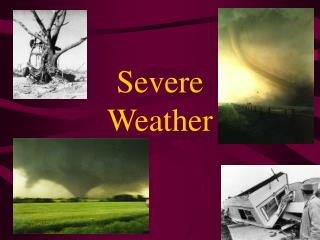
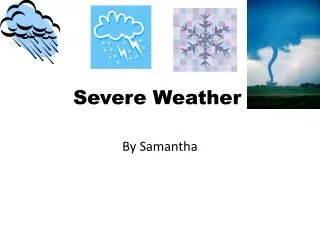
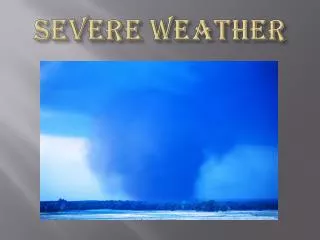
Tornadoes • Tornado is a destructive, rotating column of air that has high wind speeds and low central pressure and that touches the ground. It is visible as a funnel-shaped cloud. • Tornado is destructive due to the strong spinning winds; which have an average speed of 120-180 km/h.
Hurricanes • Hurricane is a severe storm that develops over tropical oceans and whose winds spiral in toward intensely low-pressure storm center in a speed of at least 120 km/h. • Hurricanes vary in size from 160 to 1500 km in diameter and can travel for thousands of kilometers.
Hurricane structure • Eye • Eye wall • Rain bands
Damages caused by tornadoes and hurricanes • Tornadoes can cause a lot of damage. They can uproot trees, destroy buildings, or picking up heavy objects as cars. • Hurricanes can also knock down trees and destroy buildings and homes. Most damage is caused by flooding associated with heavy rains.
Severe weather safety • Lightning is attracted to the tall objects. So, stay away from trees, and crouch down if you are in an open area. Stay away from water. • If there is a tornado, find shelter quickly, best is a basement or the center of a windowless room.
Severe weather safety • 3. If there is a flood, find a high place to wait out the flood, and stay away from flood waters. • 4. If there is a hurricane, people living on the shore will be asked to evacuate the area. • Also, you should stay indoor during the storm.