Download
1 / 28
280 likes | 409 Views
This lecture series delves into the essential elements of workflows and middleware in network computing. It explores both static and dynamic workflows, highlighting their roles in business automation, document processing, and service grids. Key topics include enabling technologies, event/task graphs, and the intricacies of workflow enactment, including task management and deadlock handling. The session covers fundamental workflow patterns such as sequences, AND-splits, and XOR merges, alongside the application of agents in hybrid systems for efficient coordination and workflow enactment.

E N D
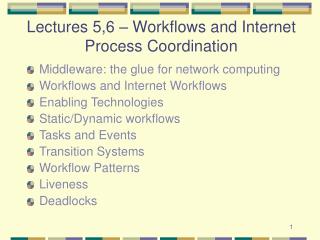
Lectures 5,6 – Workflows and Internet Process Coordination • Middleware: the glue for network computing • Workflows and Internet Workflows • Enabling Technologies • Static/Dynamic workflows • Tasks and Events • Transition Systems • Workflow Patterns • Liveness • Deadlocks
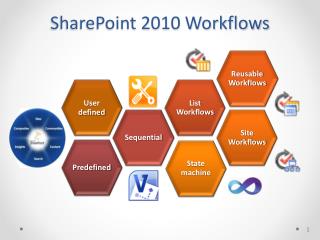
Workflows • Informal definition. • Traditional applications: • Office automation and document processing • Factory automation • Business • Internet workflows, iWM. • Examples • Service grids • Computational grids
Lifecycle of a workflow • Creation – process definition • Process verification • Cases • Workflow enactment • The Workflow Management Coalition • Multibillion $ industry • Workflow Reference Model
Static/dynamic workflows • Static workflows • Dynamic workflows • Exception handling • Reversibility.
Workflow enactment • Case: a particular instance of a workflow • Workflow enactment engine performs a coordination function • Tasks/Activities and Events.
Transition systems • A directed graph: • Nodes the states of the system • Edges events • Two distinguished states: • Initial state – no incoming edge • Goal/termination state – no outgoing edge • Example: laptop assembly. States labeled by the events causing the transition.
Algorithm to construct the transition system from the event-task graph • 1. Construct the set of E of individual events: E={1,2,3,4,5,6,7,8,9} • 2. Split it into equivalence classes based upon the causality relationship: E1 = {1,2,3,4,9} E2 = {1,5,6,7,8,9} The two sets are not disjoint!!
Algorithm to construct the transition system from the event-task graph • 3. Add to E all feasible combinations of events. Each feasible combinations contains one event from each class. Example: [2,5], [3,5] are feasible combinations [2,3] is not a feasible combination
Algorithm to construct the transition system from the event-task graph • 4. Construct the set of states S. • Initially S contains only the initial state. • Construct the set of all events feasible in that state. • For each event in that state label the state reachable when the event occurs. • Add the new state to S • Repeat the process for every state in S.
Basic workflow patterns • Sequence • AND-split • Synchronization • XOR – spli • XOR – merge • OR – split • Multiple merge • Discriminator • N out of M join • Deferred choice
Agents and workflow enactment • Hybrid systems: some tasks carried out by computers, others by humans. • Why use agents for workflow enactment?