Download
1 / 5
60 likes | 222 Views
This guide explores the concepts of solving linear simultaneous equations and break-even analysis. It explains how each pair of x and y points that satisfy a straight line equation represents coordinates on that line. The intersection of two lines solves both equations, which can be approached graphically or through methods like substitution or elimination. It also details profit calculations in business, illustrating that profit equals revenue minus costs, and defines the break-even point where costs equal revenue with no profit or loss.

E N D
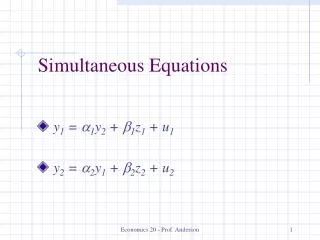
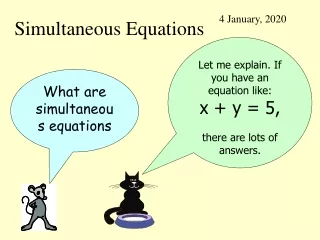
Solving linear simultaneous equations • Each pair of points x and y which satisfy an equation of a straight line will be coordinates of a point on that line. • The point where two lines intersect satisfies both equations. • You can solve simultaneous equations graphically or algebraically using the substitution method or the elimination method.
Break-even analysis • In a business, Profit = revenue – costs • Revenue is the money a company earns through sales. • Costs include labour, raw materials, equipment that go into making the product. • If costs exceed revenue, the business makes a loss. • If costs equal revenue, there will be neither profit or loss. This is the break-even point.
Example, Ex 10C, Q.4 • You do Ex 10C, 5, 6, 8