Understanding Input Devices: Types and Functions in Data Entry
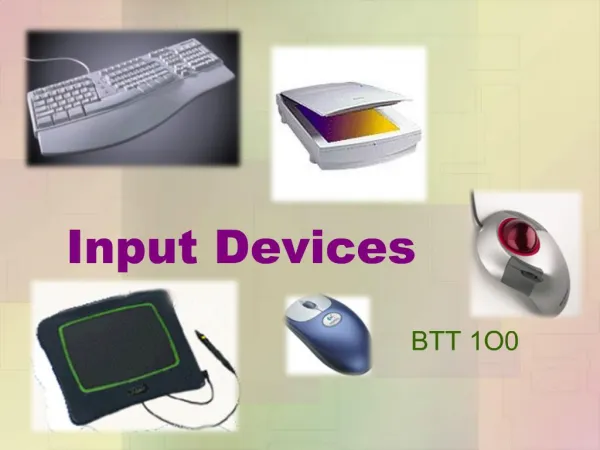
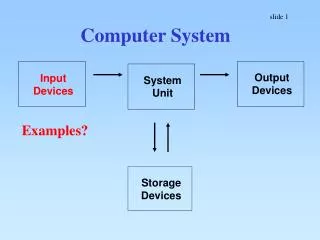
Input devices are essential components of computers, enabling users to enter data and instructions into the system. These devices encompass a variety of tools, such as keyboards (standard, ergonomic, wireless), pointing devices (mouse, trackball, touchpad, stylus), and scanners (flatbed, handheld). Input types include text, numbers, images, and audio. Additionally, advanced technologies like RFID and biometric systems enhance data entry and identity verification. This overview explores the diverse input devices and their roles in communication between users and computers.


Understanding Input Devices: Types and Functions in Data Entry
E N D
Presentation Transcript
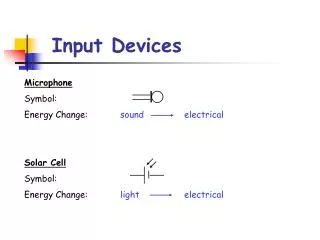
Input • Data or instructions entered into memory of computer • Input device is any hardware component used to enter data or instructions
Input - Types • Data • Unprocessed text, numbers, images, audio, and video • Commands • Programs • Commands • User Responses
Keyboards - Types Standard Ergonomic Wireless Notebook Handheld On Screen
Pointing Devices • Pointing devices are used to • select and manipulate objects • input certain types of data • to issue commands to the computer.
Pointing Devices • Wheel Mouse • Optical Mouse • Trackball • Touch Pad • Touch Screen • Stylus – Two Types • Standard • Inductive
Scanners • A scanner captures an image of a flat object in digital form and transfers that data to a computer. • The quality of scanned images is indicated by optical resolution, usually measured in the number of dots per inch (dpi).
Flatbed Pen or Handheld Sheet-fed Drum Scanners - Types
Optical Readers • Device that uses light source to read characters, marks, and codes and then converts them into digital data • OMR • Bar Code
Magnetic-Ink Character Recognition (MICR) • Banking industry almost exclusively uses MICR for check processing
RFID • Radio frequency identification (RFID) is a technology that can store, read, and transmit data located in RFID tags. • RFID tags • contain tiny chips and radio antennas • can be attached to objects, such as products, price tags, shipping labels, ID cards, assets, and more. • The data in RFID tags is read by RFID readers.
Audio Input • Audio input is the process of entering audio data into the computer. • Speech recognition systems enable the computer to recognize voice input as spoken words and require appropriate software. • Music input systems are used to create an original music composition or arrangement, or to create a custom music CD.
Video Input • Process of entering full-motion images into computer • Video can come form; • Digital Video Recorders • Web Cams
Biometric Input • Authenticates person’s identity by verifying personal characteristic • Fingerprint scanner • Hand geometry • Voice verification • Iris recognition • Facial recognition