Download
1 / 24
240 likes | 355 Views
Understanding forage quality and its economic impact is crucial for managing feed costs in ruminant livestock. Feed expenses can represent up to 75% of the cost of maintaining cattle, making it essential to analyze hay quality accurately. Key indicators such as Dry Matter (DM), Acid Detergent Fiber (ADF), Neutral Detergent Fiber (NDF), and Crude Protein (CP) inform decisions on feed management. Regular analysis and sampling of forages ensure optimal nutritional value for livestock, enabling efficient ration balancing and better economic outcomes for producers.

E N D
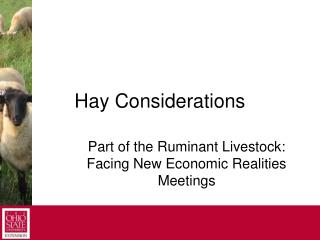
Hay Considerations Part of the Ruminant Livestock: Facing New Economic Realities Meetings
Basics • Feed cost can account up to 75% of the cost of keeping a cow. • It is generally 3x more expensive to feed an animal than to make them graze it.
Hay is Cheap? • Fertilizer replacement cost per ton of hay = $75.55 • Equipment/labor cost Per acre • Mowing - $10.50 • Tedding - $5.85 • Raking - $5.90 Baling (per bale) • Small square - $0.44 • Large Round - $17.35 • Land, Quality ??
Nutrient Removal in Hay Total = $75.55 per ton of hay Prices from February 19, 2008
Defining Forage Quality Common quality measures: • DM • ADF • NDF • CP • DDM • DMI • RFV • RFQ
Defining Forage Quality • Dry Matter (DM) • all material that is not water • Acid Detergent Fiber (ADF) • consists of cellulose & lignin • does not represent the total amount of fiber in a feed • diets low in ADF promote health problems
Defining Forage Quality • Neutral Detergent Fiber (NDF) • the best measure of total fiber • includes all of the structural carbohydrates • includes cellulose, hemicellulose & lignin • NDF is a good index of forage quality low NDF = high quality • NDF is the single best indicator of total fiber
Defining Forage Quality • Crude Protein (CP) • is the total nitrogen in a sample x 6.25 • is easily & accurately measured • CP can be used as a general indicator of forage quality high CP generally implies high quality BUT…high CP doesn’t always mean low fiber
Defining Forage Quality • Relative Feed Value (RFV) • an index used to rank forages by their potential intake of digestible dry matter • calculated from ADF and NDF, CP content is not considered in RFV • is used to allocate the correct forage to animal performance, to price hay, & to assess forage management skills • typically, higher RFV = higher price
Defining Forage Quality(New Method) • Relative Forage Quality (RFQ) • an index to rank forages by their potential intake of Total Digestible Nutrients (TDN) • a better rating when comparing grasses & legumes
Forage Quality • The Importance of Testing & Analysis • forages play an important role in animal production • forages are a high value crop & require mgmt. • livestock producers require analysis for ration balancing • forage analysis is necessary for marketing purposes
Sampling Hay • Collect one sample per lot • 10 to 20 small bales (one core per bale) • 5 to 8 large bales (4 cores per bale) • Hay probe • sharp tip • no greater than 3/4” and no less than 3/8” • 90 degree angle • avoid cutting leaves from stems • adequate sample size • penetrate bale at least 12” • never subsample, send entire sample to lab • RANDOM, RANDOM, RANDOM
Forage Quality Summary • There are many tools available to measure forage quality • Sampling forages on a periodic basis is important • There is no substitution for lab analysis • You need to know the quality of your forages to make management decisions
Protein, % High Medium Low Fiber & Lignin, % Composition, RelativeValues Leaves, % Stems, % Minerals, % Grasses Leafy Boot Heading Bloom Legumes Leafy Prebud Bud Bloom Growth Stages
Can hay meet the cows needs? • Late Bloom Orchard Grass Hay. • TDN – 54 %DM • CP – 8.4 %DM
The best time to feed our poor quality hay? • Right after weaning