Balancing Chemical Equations: A Step-by-Step Guide
60 likes | 169 Views
This guide provides a systematic approach to balancing chemical equations using a valency table. Chemical equations typically take the form A.B + C.D → A.D + C.B, where B and D switch partners. The steps involve determining the valencies of the elements, writing correct ionic formulas for each compound, applying the criss-cross rule for atom ratios, and ensuring that the total number of atoms in reactants equals those in products. Remember to only use coefficients in front of compounds when balancing.


Balancing Chemical Equations: A Step-by-Step Guide
E N D
Presentation Transcript
Balancing Chemical Equations Table to assist with balancing equations
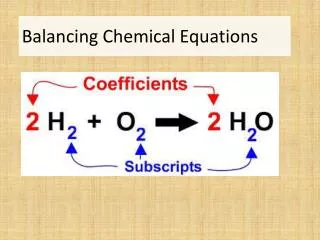
Equations take the form of: A B + C D AD + C B [ the B and the D change partners] Steps to balance the equation: 1. Refer to your valency table to establish the valency of A, B, C & D. 2. Use the valencies to write the correct ionic formulae for all 4 compounds i.e. AB, CD, AD & CB. Use the criss-cross rule to establish the correct ratio of atoms in each compound. 3. REMEMBER once you balance each ionic formula with subscripts you can only use big numbers in front of the compounds to do the next step – balancing the whole equation. 4. The number of atoms in the reactants MUST equal the number of atoms in the products. Using large numbers ONLY, in front of the ionic compounds, balance the total number of atoms on both sides of the equation.