BIOINFORMATICS Structures
This course module focuses on the critical analysis of structural alignment in proteins using iterated dynamic programming and RMS superposition. It delves into the atomic positioning, geometry, and scoring methodologies that establish structural similarity among biomolecules. Significant aspects include the superposition of structures, identification of residues, and understanding of protein geometry along with relation to functional dynamics. Students will learn about the advanced algorithms used in protein structure comparisons and develop the skills to analyze molecular conformations using real-world examples.


BIOINFORMATICS Structures
E N D
Presentation Transcript
BIOINFORMATICSStructures Mark Gerstein, Yale University bioinfo.mbb.yale.edu/mbb452a (last edit in Fall '05)
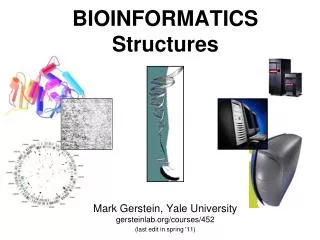
What Structures Look Like? Structural Alignment by Iterated Dynamic Programming RMS Superposition Rotating and Translating Structures Scoring Structural Similarity Contents: Structures
Atom Position, XYZ triplets Other Aspects of Structure, Besides just Comparing Atom Positions Lines, Axes, Angles Surfaces, Volumes
What is Protein Geometry? • Coordinates (X, Y, Z’s) • Derivative Concepts • Distance, Surface Area, Volume, Cavity, Groove, Axes, Angle, &c • Relation to • Function, Energies (E(x)), Dynamics (dx/dt)
Hb Automatic Alignment to Build Fold Library Alignment of Individual Structures Fusing into a Single Fold “Template” Mb Hb VLSPADKTNVKAAWGKVGAHAGEYGAEALERMFLSFPTTKTYFPHF-DLS-----HGSAQVKGHGKKVADALTNAV ||| .. | |.|| | . | . | | | | | | | .| .| || | || . Mb VLSEGEWQLVLHVWAKVEADVAGHGQDILIRLFKSHPETLEKFDRFKHLKTEAEMKASEDLKKHGVTVLTALGAIL Hb AHVD-DMPNALSALSDLHAHKLRVDPVNFKLLSHCLLVTLAAHLPAEFTPAVHASLDKFLASVSTVLTSKYR------ | | . || | .. . .| .. | |..| . . | | . ||. Mb KK-KGHHEAELKPLAQSHATKHKIPIKYLEFISEAIIHVLHSRHPGDFGADAQGAMNKALELFRKDIAAKYKELGYQG Elements: Domain definitions; Aligned structures, collecting together Non-homologous Sequences; Core annotation Previous work: Remington, Matthews ‘80; Taylor, Orengo ‘89, ‘94; Artymiuk, Rice, Willett ‘89; Sali, Blundell, ‘90; Vriend, Sander ‘91; Russell, Barton ‘92; Holm, Sander ‘93; Godzik, Skolnick ‘94; Gibrat, Madej, Bryant ‘96; Falicov, F Cohen, ‘96; Feng, Sippl ‘96; G Cohen ‘97; Singh & Brutlag, ‘98
Automatically Comparing Protein Structures • Given 2 Structures (A & B), 2 Basic Comparison Operations 1 Given an alignment optimally SUPERIMPOSE A onto B Find Best R & T to move A onto B 2 Find an Alignment between A and B based on their 3D coordinates Core Given a alignment, find a superposition Given a superposition, find an alignment
RMS Superposition (1) B A Core
RMS Superposition (2):Distance Betweenan Atom in 2 Structures Core
RMS Superposition (3):RMS Distance BetweenAligned Atoms in 2 Structures Core
RMS Superposition (4):Rigid-Body Rotation and Translationof One Structure (B) Core
Rotation Matrices 2D 3D
RMS Superposition (5):Optimal Movement of One Structure to Minimize the RMS Core Methods of Solution: springs(F ~ kx) SVD Kabsch
Structural Alignment (1c*)Similarity Matrixfor Structural Alignment • Structural Alignment • Similarity Matrix S(i,J) depends on the 3D coordinates of residues i and J • Distance between CA of i and J • M(i,j) = 100 / (5 + d2)
Alignment (2): Dynamic Programming,Start Computing the Sum Matrix new_value_cell(R,C) <= cell(R,C) { Old value, either 1 or 0 } + Max[ cell (R+1, C+1), { Diagonally Down, no gaps } cells(R+1, C+2 to C_max),{ Down a row, making col. gap } cells(R+2 to R_max, C+2) { Down a col., making row gap } ]
Alignment (5): Traceback Find Best Score (8) and Trace BackA B C N Y - R Q C L C R - P MA Y C - Y N R - C K C R B P
Generalized Similarity Matrix • PAM(A,V) = 0.5 • Applies at every position • S(aa @ i, aa @ J) • Specific Matrix for each pair of residues i in protein 1 and J in protein 2 • Example is Y near N-term. matches any C-term. residue (Y at J=2) • S(i,J) • Doesn’t need to depend on a.a. identities at all! • Just need to make up a score for matching residue i in protein 1 with residue J in protein 2 i J
Use of Generalized Similarity Matrix in Sequence Comparison, Structure Comparison, & Threading
ACSQRP--LRV-SH -R SENCVA-SNKPQLVKLMTH VK DFCV- In Structural Alignment, Not Yet Done (Step 6*) • Use Alignment to LSQ Fit Structure B onto Structure A • However, movement of B will now change the Similarity Matrix • This Violates Fundamental Premise of Dynamic Programming • Way Residue at i is aligned can now affect previously optimal alignment of residues(from 1 to i-1)
How central idea of dynamic programming is violated in structural alignment Core Same theme as the Sec. Struc. alignment
Structural Alignment (7*), Iterate Until Convergence 1 Compute Sim. Matrix 2 Align via Dyn. Prog. 3 RMS Fit Based on Alignment 4 Move Structure B 5 Re-compute Sim. Matrix 6 If changed from #1, GOTO #2
Score S at End Just Like SW Score, but also have final RMS S = Total Score S(i,j) = similarity matrix score for aligning i and j Sum is carried out over all aligned i and j n = number of gaps (assuming no gap ext. penalty) G = gap penalty Score the same way as for sequences with EVD