Download
1 / 19
190 likes | 311 Views
The CREST project at UW-Madison aims to foster collaboration between faculty, instructional staff, and undergraduates to create physical molecular models and curricular materials. These resources bridge faculty research and undergraduate instruction within the Biology Core Curriculum (Biocore), impacting 120-150 students annually. The project emphasizes critical thinking and problem-solving through various courses, including Cell Biology and Evolution. Outcomes include improved engagement, curriculum design, and assessment strategies, ultimately enhancing the educational experience in the life sciences.

E N D
CREST UW-Madison Partnership Devan Van Lanen – Wanek Michelle Harris Biocore, UW – Madison
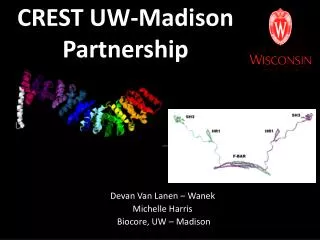
Project conception • Goal: facilitate partnerships between UW-Madison faculty, instructional staff, and undergraduates to develop physical molecular models/curricular materials -Models help connect faculty research with undergraduate instruction • Two UW-Madison CREST teams • β-CATENIN – Amy Moser and Jeff Hardin • F-BAR – Erik Dent
Biocore • 4 semester honors biology program • Broad, in-depth, and integrated knowledge • Emphasis on problem solving, critical thinking, research, writing, and the process of science
Biology Core Curriculum (Biocore) ~120- 150 students/ year Freshman courses: chemistry & math Biocore 301/302- Evolution, Ecology and Genetics Upper level courses ********* ~35 different biological science majors Biocore 303/304- Cell Biology Biocore 323/324- Organismal Biology Biocore 333- Biological Interactions (capstone)
CREST Project Focus ~120- 150 students/ year Freshman courses: chemistry & math Biocore 301/302- Evolution, Ecology and Genetics Upper level courses ********* ~35 different biological science majors Biocore 303/304- Cell Biology Biocore 323/324- Organismal Biology Biocore 333- Biological Interactions (capstone)
Biocore 333: Biological Interactions • Explore 4 topics through primary literature research papers • Evaluate experimental design, comprehend the science behind the methods and techniques • Interconnection of biological systems and integration of knowledge from past courses
Developing new materials • Biocore 333 topic: APC and colon cancer • β-catenin as cellular proto-oncogene
Learning Goal Students will describe mutations or changes that need to occur in the proteins in a pathway for deregulation to occur
Developing new materials • Use physical models & and other educational materials to help students achieve learning goals • Worksheet and exam questions for evaluation • Using data to assess efficacy of physical models/ curricular materials in learning 1JDH – with TCF-4 1JPP – with APC
Curricular details • Puzzle activity in discussion, early April 2012 • WNT present, WNT absent, β-CATENIN from tumor, APC from FAP patient • Models to be used in review session in May 2012 • Models show that the interaction domain for APC, E-caderin and TCF is the same
β-catenin Evaluation details • Pre- and Post-SALG • Worksheet question: previously groups often answered wrong • “You then decide to screen for mutations in the β-catenin gene. Describe the types of mutations you would expect to find and explain how they would affect the function of the protein. “ • Preliminary data: Only 3 of 18 groups got the question wrong! • Exam question about types of mutations in β-catenin gene that would lead to tumor development – individual assessment
CREST Project Focus ~120- 150 students/ year Freshman courses: chemistry & math Biocore 301/302- Evolution, Ecology and Genetics Upper level courses ********* ~35 different biological science majors Biocore 303/304- Cell Biology Biocore 323/324- Organismal Biology Biocore 333- Biological Interactions (capstone)
Biocore 303: Cellular Biology • Learning Goal #1: Understand that endocytosis requires several different proteins & explain/ recognize/predict how this affects endocytic shape • Learning Goal #2: State a hypothesis/draw a diagram about how an protein’s activation affects its function in different cellular processes • Learning Goal #3: Understand that “1 protein ≠ 1 function”. Students will recognize/ predict/ graph protein function based on cell location & other molecules present
Curricular details Clickable landscape used by all students as part of graded homework assignment
F-BAR models used by half of discussion sections as they do homework
F-BAR Evaluation details • Pre- and Post-SALG • Graded homework • Final exam questions about novel protein: predicting function from structure & location
Project Challenges • Challenges of evaluating efficacy of physical model & puzzle activity • Difficulty of dividing students into control and experimental groups in one class • Inability to use past student data • Time!! (e.g., no time for Jmoltutorial) • TA training • Restricting online materials to treatment groups • IRB (‘nuff said)
Happy Stuff • Engagement of faculty with undergraduates • F-BAR publication from Dent lab with CREST undergrad as second author • New research directions in Dent lab, partly inspired by modeling project • Undergraduates experience curricular design
Future plans • Recruit new Biocore students to work with faculty to develop models & curricular materials • Revise curricular materials & assessment plan for spring 2013 • Publications • Erik Dent – reflection piece • CBE-Life Science Education manuscript??