Understanding the Imperfect Tense in Spanish: Usage and Examples
The imperfect tense in Spanish is essential for discussing past actions that occurred repeatedly or over an extended time. It often refers to actions during a non-specific time period and is indicated by phrases such as "used to" or "would." Setting the scene in stories is another vital aspect, highlighting ongoing actions without a defined endpoint. Key verb endings in the imperfect include aba, ía, and the irregular forms of ir and ser. This guide provides clarity on using the imperfect tense effectively in everyday communication.

Understanding the Imperfect Tense in Spanish: Usage and Examples
E N D
Presentation Transcript
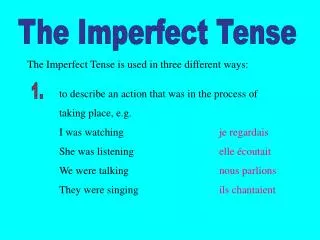
When do you use the imperfect tense? • When talking about events that happened repeatedly or over an extended period of time in the past. • an action that took place during a non-specific period of time. • When using key phrases like: used to, was + -ing, would, always. • When setting the scene for a story
I used to live in Chicago. • Non-specific period of time. • The clue “used to”
Aly always ate eggs for lunch. • She did this many, many times (not specific) • It would be virtually impossible to find out how many times she ate eggs for lunch.
Angie was a good joke teller. • Description of something ongoing. • No action involved other than being so the time frame must have been most of Angie’s life. • The exact amount of time is therefore irrelevant.
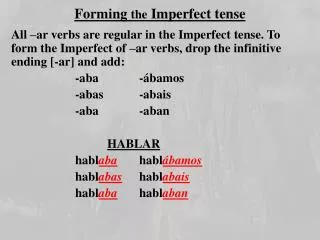
aba abas aba ábamos abais aban - ar verb endings
ía ías ía íamos íais ían - er/ir verb endings
iba ibas iba íbamos ibais iban ir
era eras era éramos erais eran ser
veía veías veía veíamos veíais veían ver
Another way to show “-ing” in the past: • Just use the present progressive, but change the verb estar into the imperfect tense. • Estaba estudiando. = I was studying.