Download
1 / 18
180 likes | 322 Views
This journal entry invites reflection on a time of perseverance amidst challenges, allowing us to explore resilience in the context of historical suffering, specifically during the Holocaust and at Auschwitz. The class discussion will delve into themes of guilt and the experience of inmates who faced extreme adversity. As we read Chapter 1 and complete guided notes, we will examine the harsh realities of life in concentration camps, including forced labor, inadequate living conditions, and the psychological battles faced by those who sought to survive.

E N D
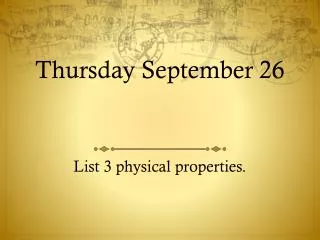
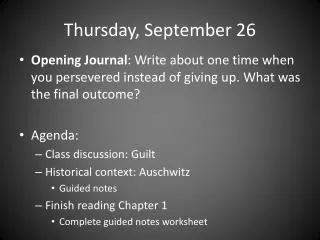
Thursday, September 26 • Opening Journal: Write about one time when you persevered instead of giving up. What was the final outcome? • Agenda: • Class discussion: Guilt • Historical context: Auschwitz • Guided notes • Finish reading Chapter 1 • Complete guided notes worksheet
Holocaust “olos” - whole Kaustos/kautos - burnt Destruction or slaughter on a mass scale
Concentration Camps • How did they start? • Exploiting the labor of concentration camp prisoners • Who was imprisoned? • Political prisoners, resistance groups, and groups deemed racially inferior
Auschwitz Camp Complex • 3 large camps • Auschwitz I • Auschwitz II (Birkenau) • Auschwitz III (Monowitz)
Auschwitz I • Administrative • Prisoners
Auschwitz II - Birkenau • Labor • Extermination
Auschwitz III - Monowitz • Labor camp • Manufacturing synthetic materials
Daily Life - Housing • Barracks • No windows • No protection from heat or cold • No bathrooms, only a bucket
Daily Life - Food • Watery soup with rotten vegetables (no meat) • Few ounces of bread • A bit of margarine, tea, or a bitter drink resembling coffee • Dehydration, hunger
Daily Life -Labor • Forced labor inside camp • Examples: • Women sorting prisoner belongings • Forced labor outside of camp • Examples: • Coal mines or rock quarries • Construction • Factories
“Most prisoners at Auschwitz survived only a few weeks or months. Those who were too ill or too weak to work were condemned to death in the gas chambers. Some committed suicide by throwing themselves against the electric wires. Others resembled walking corpses, broken in body and spirit. Yet other inmates were determined to stay alive.” United States Holocaust Memorial Museum
Tattoos • Prisoners only received tattoos at Auschwitz • Only those who were selected for work received numbers • Used to identify bodies of registered prisoners who had died
Conflict • Internal conflict • Mental or emotional struggle that occurs within a character • External conflict • Struggle that occurs between a character and outside forces (could be another character, the environment, etc.)
Steven Springfield – Conditions in the Stutthof Concentration Camp http://www.ushmm.org/outreach/en/media_oi.php?MediaId=1220
http://www.ushmm.org/outreach/en/media_oi.php?ModuleId=10007718&MediaId=1188http://www.ushmm.org/outreach/en/media_oi.php?ModuleId=10007718&MediaId=1188 Miso Vogel Describes arrival at Auschwitz