Risk Management
60 likes | 176 Views
This guide explores the essential characteristics of risk, emphasizing its uncertainty and potential for loss. It highlights the three dimensions of risk: nature, scope, and timing. Effective risk management involves identifying risks, estimating damage, and prioritizing issues to develop mitigation strategies. It also categorizes risks related to the entire project, specific developments, technical challenges, and stakeholder communication. Understanding the difference between known and predictable risks, and generic versus product-specific risks enhances project planning and execution.


Risk Management
E N D
Presentation Transcript
Risk Management Planning for Problems
Characteristics of Risk • Risk has two principle characteristics • Uncertainty – It may or may not happen • Loss – If it happens, losses will occur • Risk varies along three dimensions • Nature – What goes wrong • Scope – What does it affect • Timing – When does it happen and for how long
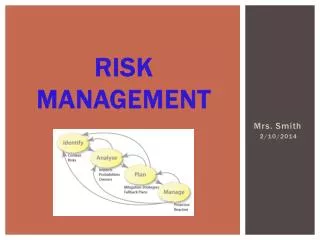
Risk Management: Purpose and Process • We manage risks to proactively prevent “bad things” from happening to our project • How to Do It • Identify Risks • Estimate Damage • Likelihood • Impact • Prioritize Problems • Develop Mitigation Plan • Monitor and Act
Types of Risk (Entire Project) • Project – Threaten project plan by change in budget, schedule, personnel, etc. • Technical – Problem harder than estimated • Business – Wrong product, presentation, or loss of management support
Types of Risk (in Development) • Size of Task – Problem in scoping • Business Impact – Problems with meeting market constraints • Customer Disconnect – Loss, lack, or inability to communicate with customer • Process Problems – Lack or disregard in following development process • Dev Environment – Problems with availability, quality, or understanding of development tools • Technology – Risk of newness, difficulty, or complexity • Experience – missing skills, insufficient self-discipline, lack of time and attention
Additional Points of Emphasis • Difference between known and predictable risks (pg 746 7/e, pgs 696-697 6/e) • Difference between generic and product-specific risks (pg 747 7/e, pg 697 6/e) • Important questions for determining project risk (pgs 748-749 7/e, pgs 698-699 6/e) • Prescriptive advice for developing a risk table (section 28.4.1 and scenario pg 754 7/e, section 25.4.1 and scenario pg 704 6/e)