
Comprehensive Short Course on Game Theory: Strategic Behavior and Applications
This short course, guided by Hamed Ghoddusi, delves into the fundamentals of Game Theory, exploring strategic behavior, decision-making, and game dynamics. Participants will learn about game definitions, typical examples, states and strategies, and solution concepts like Nash equilibrium. The course covers extensive and normal forms, perfect and imperfect information, and various applications in real-world scenarios such as industrial competition, auctions, and voting. Engage in discussions about key games, including the Prisoner's Dilemma and bargaining strategies, to enhance your understanding of strategic interactions.

Comprehensive Short Course on Game Theory: Strategic Behavior and Applications
E N D
Presentation Transcript
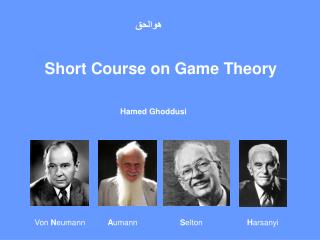
هوالحق Short Course on Game Theory Hamed Ghoddusi Von Neumann Aumann Selton Harsanyi
“In war the will is directed at an animate object that reacts.” - Karl Von Clausewitz, On War
Course Plan • Part 1: Definition of games, Typical Examples of Games, Common Knowledge, Expected Utility, States and Strategies • Part 2: Extensive Forms with Perfect Information, Backward Induction, Imperfect Information, Incomplete Information, Normal forms • Part 3: Solution Concepts: Rationalizibility, Strong and Weak Dominance, Nash equilibrium, Bayesian-Nash equilibrium, Correlated equilibrium , Sub-game perfection, signalling games • Part 4 (If time permits): Trembling hand, repeated games, supermodular games
Game Theory • Study of strategic behavior • Strategic behavior : Taking into account the behavior of other • players
Examples of Strategic Behavior • Industrial Competition • Firm / Capital market relationship • Voting decisions • Auctions/Biddings • …
Game to be discussed in the class: • Shareholders voting game • Search models • Durable goods monopolist • R&D • Bargaining • Job market signaling • …
Games We Study • Played once / more than once • Finite number of players • Finite/infinite strategy space
Prisoner’s Dilemma Silent Cooperate 1 , 1 10 , 0 Silent 0 , 10 8 , 8 Cooperate
Chicken Game Drive Stop -100 , -100 1 , 0 Drive 0 , 1 Stop 0 , 0
Hawk and Dove Hawk Dove (V-C)/2 V , 0 Hawk 0 , V Dove V/2
Battle of Sexes Theater Restaurant Theater 10 , 5 4 , 4 Restaurant 5 , 10 4 , 4
Game Theory Decision Theory Representation Theory Solution Theory
ٍExtensive Form • Players • Rules of Game • Strategies
Normal Form • Players • Space of Pure Strategies • Payoffs
Games • Competitive : zero-sum games , non zero-sum games • Non Competitive : supermodular (complementary) games • search games for instance
Games • One shot games • Repeated games
Information • Perfect Information : Chess • Imperfect Information : Cards • Incomplete Information
Characteristics of Players • Self-interested, utility maximizer • Rational : Friedman’s “as if” paradigm • Remark: One person and several identity situation
Decision Under Uncertainty • Decision over lotteries • Von Neumann Morgenstern expected utility • Risk Aversion
States • Mutually exclusive • Collectively exhaustive • Independent of players decision
Bayesian Decision Making • Updating of prior beliefs • P(E|E’)= P(E∩E’) / P(E’)
Strategy Detailed plan of actions, contingent to any possible occurrence in the game : a plan that you could leave to somebody else playing for you. Strategy as a function which maps states of the world to the actions A W
Strategy • Strategy in the simultaneous move games • Strategy in the Bayesian games • Finite and infinite strategy space
Example 1 : How many strategies? L 2 L H 1 L H 2 M H
Example 2 : Equivalent Normal Form? 1 L H 2 2 H L H L
What do you think if strategies always assign the same value to some elements of the domain?
Strategy in Extensive Form A strategy for player X is a sub-tree of a game tree which satisfies the following conditions: • It is rooted at the root of the game tree • whenever it is player X's turn at a node that belongs to the subtree, exactly • one of the available moves belongs to the subtree; • whenever it is not player X's turn at a node that belongs to the subtree, all • of the available moves belong to the subtree
Bargaining Games • Gains from trade, the problem of distribution of benefits • In the absence of market • Disagreement value • Rubenstein smart solution
Real Life Example • Company-Union Negotiations
Extensive Form Games • Set Theoretic Definition • Graph Theoretic Definition
Set Theory Representation • (W,N) • W set of Plays • N collection of non-empty sub-sets of W (Nodes) • {w} є N • Predecessor function
Set Theory Representation • Plays : States • Nodes : Events • Moves • Terminal Moves
Example 1 2 2 2 w5 w6 w3 w4 w2 w1
Example : Modeling of Bargaining • W = ? • N = ?
Graph Theoretic Representation • Graph (V,E) • Nodes (States) • Branches (Actions) • History • Immediate Predecessor
Example 1 H A N 2 2 2 H A A N H N
Games with Perfect Information • An Extensive Form • Assignment of Decision Points • Pay off function ** Simultaneous move is ruled out.
Games with imperfect Information • An Extensive Form • Collection of Information set • Pay off function
Example 1 2 2
Sub Games • Sub-tree • Contains the whole information set
Example: Noisy Stackelberg L 2 1 H QL 2 1 QH 2
Strategy Space The product structure of strategies of all players S = S1 * S2 * S3 * … * Sk = ∏ Si S(-i) = Strategies of all player but player (i)
Pure Strategy vs Mixes Strategy The subset of pure strategies entering the mix with a strictly positive weight is the support of the mixed strategy. Point: A pure strategy may be strictly dominated by a mixed strategy even if it does not strictly dominated by any pure strategy
Behavioral Strategy vs Mixes Strategy When a player implements a mixed strategy, she spins the roulette wheel a single time; the outcome of this spin determines which pure strategy (set of deterministic choices at each information set) she will play. When she implements a behavior strategy, she independently spins the roulette wheel every time she reaches a new information set.